

ACL Tear Recovery Without Surgery: Is It Really Possible?

You’ve done the scan, heard the words “torn ACL,” and now your brain is stuck on one question: Do I really need surgery? Maybe your knee feels “mostly okay” until you turn too fast, step off a curb, or try to get back to training; then it wobbles, and your confidence disappears. If you're in Central Hong Kong and weighing ACL tear recovery without surgery — or exploring acl non surgical treatment options — you're not alone.
Disclaimer: This article is for general education and decision support. It can’t diagnose your injury or replace an in-person evaluation. If you’ve had a major injury, severe swelling, locking, repeated giving-way, or concern for additional damage (like a meniscus injury), seek care from a qualified clinician.
Defining ACL Tear Recovery Without Surgery
ACL tear recovery without surgery is less about “the ligament looks perfect again” and more about whether your knee can handle real life safely.
For many clients, “success” looks like moving through daily life without the knee buckling, keeping swelling calm (or at least predictable) after activity, rebuilding strength and control in the leg, especially in single-leg tasks, and feeling that trust return over time. It’s also important to name the other side of the coin: if your knee repeatedly gives way, you may be functionally “okay” some days, but at higher risk on the days it matters.

Non-Surgical ACL Rehab: The 3 Phases
Here’s the simplest way to think about non-surgical rehab, especially if you’re overwhelmed:
- Phase 1: Calm The Knee: Reduce swelling and irritation, restore comfortable range of motion, and rebuild basic walking mechanics.
- Phase 2: Rebuild Capacity: Progressive strength (quads, hamstrings, hips, calves), balance and control work (especially single-leg), and gradual exposure to load (not random “testing”).
- Phase 3: Prove Stability Under Load: Higher-demand movements like deceleration, step-downs, and directional control; sport-specific patterns if relevant (cutting/pivoting only when appropriate); and clear criteria for “ready” rather than hope-based timelines.
To make this less abstract, here’s what those phases often look like in daily life. In Phase 1, progress can be as simple as walking more smoothly, getting in and out of a chair without guarding, and waking up with less stiffness and swelling. In Phase 2, it often looks like rebuilding strength so stairs feel controlled again, single-leg balance stops feeling “shaky,” and your knee can tolerate longer walks without flaring. In Phase 3, the question becomes: can you handle real-world demands, like turning to pick something up, stepping down quickly, or changing direction without that split-second fear that the knee will slip?
This is where many people get stuck: they feel better in Phase 1–2, then jump too early into Phase 3 and interpret a setback as failure. Often it’s not failure. It’s feedback.
What Non-Surgical Care Usually Includes
High-quality acl non surgical treatment typically includes structured physical therapy with progressive loading, strength and neuromuscular training (control, timing, coordination), and a plan for activity modification while your knee earns back stability. In some cases, a brace is used temporarily, especially early on or for specific activities. The key piece is re-testing over time because your knee is not static.
American Academy of Orthopaedic Surgeons (AAOS) notes that whether an ACL injury requires surgery varies from person to person and depends on factors like activity level, degree of injury, and instability symptoms.
Who ACL Tear Recovery Without Surgery Fits
Most people don’t need more opinions. They need clearer signals. With ACL tear recovery, the question isn’t “can I tolerate it today?” It’s whether your knee is becoming more stable over time with structured rehab.
The visual below summarizes the big decision points: green flags that often mean your knee is adapting (better control, predictable swelling, stable daily movement), and red flags that often mean the knee isn’t tolerating demand (repeated giving way, stalled progress, or signs of additional damage).
Green Flags For ACL Tear Recovery Without Surgery Now

Green flags are not guarantees, but they’re strong signs you may do well with nonoperative management:
- Stable Daily Movement (you can walk and manage stairs without repeated buckling)
- Improving Control (single-leg tasks are getting steadier over time, with guidance)
- Predictable Swelling (it settles rather than escalating after basic activity)
- Confidence That’s Rebuildable (fear is present, but improves as control improves)
- An Adaptable Lifestyle (you’re willing to modify high-risk movements for a period)
A helpful way to read these is to ask: Is your knee responding to training like a system that can adapt? Stable daily movement and predictable swelling usually mean your knee is tolerating load in a way you can build on. Improving control matters because it suggests your body can re-learn timing and coordination, not just strength. And rebuildable confidence is not “in your head.” It’s a real signal that your nervous system is starting to trust the movements again.
This is also why many clinicians support a rehab-first approach in select cases—especially when the knee is showing steady, measurable improvement.
In the KANON randomized trial published in the New England Journal of Medicine (young, active adults), a rehab-first strategy with optional delayed reconstruction was not inferior to early reconstruction at 2 years, and it reduced the number of reconstructions performed.
That doesn’t mean “no surgery is best.” It means a rehab-first pathway can be a valid option for a meaningful subset of people, when the knee behaves well.
Knee Signals: Swelling, Buckling, Confidence
For beginners, it helps to treat your knee like a dashboard with three main indicators.
Swelling is a load-tolerance signal if it rises after activity and takes days to settle; that’s useful information. Buckling or “giving way” is a stability signal; when it happens, it’s not just discomfort; it’s your knee losing control under demand. Confidence matters too, because your nervous system tracks threat: if your knee feels unpredictable, your body will brace, hesitate, or avoid, often before you consciously decide.
It’s also worth saying plainly: an MRI can confirm structure, but it doesn’t automatically tell you how well your knee will function day to day. Function is something you test, measure, and build.
If you’re unsure what “giving way” actually means, here’s a simple description: it’s that moment where the knee feels like it briefly shifts, slips, or collapses, and you have to catch yourself to avoid falling. Many people describe it as a “drop” or a “slide,” not just pain. Pain can be present or absent. The key feature is loss of control.
This is why “I can walk fine” can coexist with “I don’t trust my knee when I turn.” Both can be true.
Activity Level And Lifestyle Fit
Non-surgical recovery is more realistic when your goals match what your knee can safely handle in the short-to-medium term. If you need to return quickly to pivoting/cutting sport, work on uneven ground, or carry heavy loads daily, your decision criteria will be different than someone whose main goal is stable daily function plus straight-line fitness.
It also helps to get specific about your “highest-risk moments.” For some clients, it’s a sport. For others, it’s carrying a child while turning, stepping off a bus or MTR escalator, moving quickly on wet floors, or working long hours on their feet. The best plan accounts for the life you actually live, not the life a generic protocol assumes.
AAOS also emphasizes that what happens naturally without surgery varies and is influenced by activity demands and instability symptoms.

When ACL Tear Recovery Without Surgery May Not Be Enough
This section isn’t meant to scare you. It’s meant to prevent you from burning months on a plan your knee is clearly rejecting.
Red Flags That Point Beyond ACL Tear Recovery Without Surgery

Red flags are thresholds, not moral judgments. Common ones include:
- Repeated giving-way episodes (especially during normal daily movements)
- Inability to regain control despite consistent rehab
- Persistent swelling that flares with basic activity
- A knee that feels unstable even in straight-line tasks
- Suspicion of (meniscus/cartilage) based on symptoms like locking/catching.
AAOS notes that instability and combined injuries are part of why some people are advised toward surgical management.
Why “Giving Way” Matters
A “giving way” episode is more than an annoyance. It can be a sign that the knee is failing to control translation and rotation under load. Over time, that can stress other structures, especially the meniscus. This is one reason clinicians take instability seriously: it’s not just about returning to sport; it’s about protecting joint surfaces long-term.
A useful way to think about it is this: a knee that “gives way” is telling you it cannot consistently manage unpredictable load. That’s the exact scenario where secondary structures may take the hit, especially when the slip happens during turning, stepping down, or quick deceleration.
Safety Gates: When To Escalate
Think of escalation as a safety gate, not a defeat. If you’re having repeated instability after a structured rehab attempt, if your symptoms suggest more complex internal injury, or if your goals require high-demand movement and your knee can’t demonstrate stability under controlled testing, it’s reasonable to get a specialist opinion.
And it’s common for this decision to evolve, even with good rehab.
In the KANON trial’s 5-year follow-up indexed on PubMed, 30 of 59 (51%) in the optional-delayed group ultimately had delayed ACL reconstruction. At the same time, overall outcomes remained similar between early reconstruction and a rehab-first strategy with optional delayed surgery.
How ATLAS Supports ACL Tear Recovery Without Surgery
Here’s where we slow everything down and make it practical. The knee doesn’t need motivation. It needs clarity.
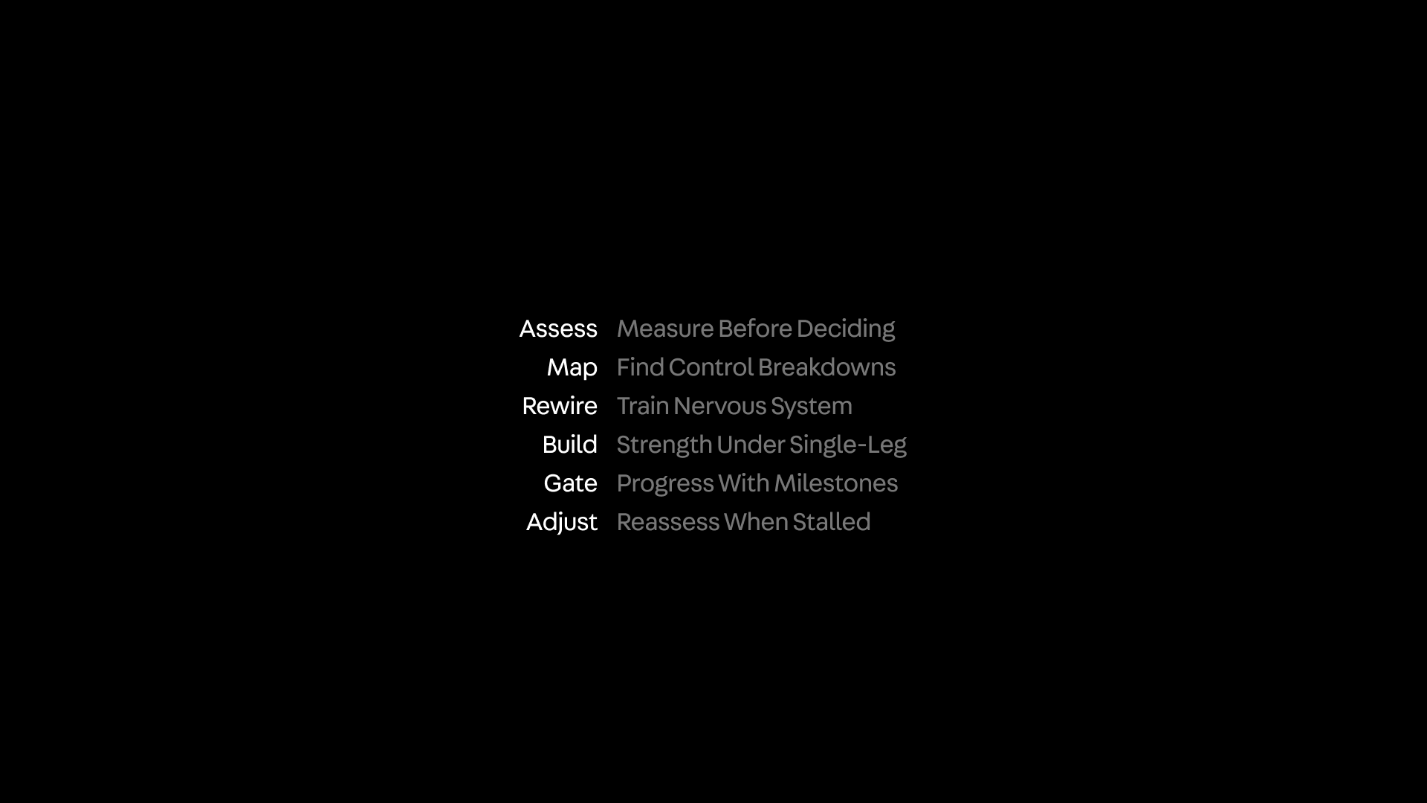
Assessment Before Decisions
At ATLAS, our bias is simple: We assess, we don’t guess.
A solid ACL-focused assessment should look beyond the MRI report. It should answer how your alignment holds up under load and whether your hip, knee, and ankle can coordinate under single-leg demand. It should also clarify where control breaks down (strength, timing, endurance, or fear response) and which movements reliably trigger symptoms. This keeps care from becoming generic. It also reduces the mental noise: you stop relying on “good days” and start relying on measurable signals.
Nervous System And Knee Control
An ACL injury isn’t just a ligament problem. It’s also a coordination problem.
When the nervous system senses threat, it can tighten and brace (creating stiffness and compensations), delay muscle firing (reducing stability at the wrong moment), and avoid positions that you actually need to retrain safely. That’s why two people with the same scan can feel completely different. Your knee stability is partly mechanical and partly neurological control.
This is also why reassurance alone isn’t enough. Confidence improves when your nervous system gets repeated proof: the knee can load, control, and recover without a flare. That proof comes from the right progressions at the right time.
Progress Gates And Milestones
Instead of vague timelines, we use progress gates: clear markers that guide next steps:
- Swelling response improves (your knee tolerates more without flaring)
- Single-leg control becomes consistent (not just “once on a good day”)
- Strength and endurance targets progress (especially quads/hamstrings/hips)
- Movement confidence improves alongside measurable control.
To keep this beginner-friendly, it helps to translate those gates into everyday examples. Improved swelling response can look like being able to take longer walks or stand longer without the knee puffing up later that day. Consistent single-leg control can look like stepping down stairs without wobbling or collapsing inward. Strength and endurance progress can look like your leg doing the work again, rather than your hip or back compensating. And confidence is often the last to return, but when it does, it usually follows measurable control.
When those markers aren’t moving, we don’t push harder. We reassess what’s limiting progress and adjust the plan.
Can an ACL tear heal without surgery?
Yes, some people regain strong, reliable function without reconstruction, but it depends on what you mean by “heal.”
An ACL can be torn yet still allow a stable, high-functioning knee if you build enough strength, coordination, and control around it. This is why a rehab-first plan with the option of delayed surgery is commonly used, especially when the knee does not feel like it is giving way.
What “success without surgery” usually looks like:
- Swelling and pain settle, and you regain a comfortable range of motion.
- Quadriceps and hip strength return so the knee is supported during daily movement.
- Neuromuscular control improves (balance, landing mechanics, deceleration control).
- Instability episodes are rare or absent, even as activity increases.
Why the rehab-first approach is taken seriously:
In the KANON randomized trial, young, active adults were assigned to either early ACL reconstruction plus rehab or structured rehab with the option of later reconstruction if needed, and the study supports the idea that many people can start with rehab and still do well, with surgery reserved for those who remain unstable.
When surgery becomes more likely (even if you start with rehab):
- The knee repeatedly “gives way” during normal life or rehab progressions.
- You have goals that require reliable pivoting and rapid direction changes (for example, field or court sports).
- There is an associated injury that changes the plan (meniscus tears that need repair, repeated swelling, or mechanical symptoms).
The simplest way to frame it: Rehab can restore function for many people. Surgery is usually considered when the knee can’t become reliably stable for the life you need to live..
How long does it take to recover from an ACL tear without surgery?
The timeline varies because “recovery” is really two different goals:
- Return to normal daily life
Many people can walk, use stairs, and handle basic routines once swelling settles and strength starts returning. Early rehab commonly starts within the first weeks, but the pace depends on pain, swelling, and how stable the knee feels. - Return to high-demand sport or pivot-heavy work
This usually takes months, not weeks, because you are rebuilding strength (especially quadriceps), control (balance and movement quality), and tolerance for faster, more complex loading (deceleration, lateral movement, sport-specific drills).
In a rehab-first strategy, the “finish line” is not a calendar date. It is meeting functional milestones without swelling or giving way.
A practical way to explain the stages readers can understand:
- Early phase: reduce swelling, normalize range of motion, re-activate quadriceps, regain confident walking.
- Middle phase: progressive strengthening and stability work, more demanding balance and control training.
- Late phase: controlled return to running or impact (if appropriate), then cutting/pivot work only when stability and control are proven.
The AAOS guideline discusses how factors like activity demands, stability, and associated injuries influence who does well with rehab-first care and who may need reconstruction sooner.
Can you walk with a torn ACL?
Often, yes, especially once the initial swelling and pain settle. Many people can walk in a straight line because walking is mostly a forward motion that does not demand as much rotational stability from the ACL.
Why it can still feel “fine” walking, but unstable doing other things:
- The ACL is most stressed during pivoting, cutting, quick direction changes, and sudden stops.
- Those movements create rotational forces that a torn ACL can no longer control as well.
What people commonly notice:
- A “pop” at the injury, followed by swelling.
- A feeling of instability or “giving way,” especially with turning or stepping awkwardly.
A simple safety note readers should understand: Being able to walk does not mean the knee is ready for sport, running, or twisting tasks. If walking triggers sharp pain, buckling, or swelling, it is a sign to scale back and get assessed.
What exercises should you avoid early?
Early rehabilitation focuses on reducing swelling, restoring controlled motion, and rebuilding strength without triggering instability. During this phase, certain movements tend to overload the healing knee and are best avoided.
Most important points to keep in mind:
- Pivoting, cutting, or twisting movements
- Jumping, hopping, and sudden deceleration
- Any exercise that causes buckling, sharp pain, or next-day swelling
These movements place high rotational or shear stress on the knee before strength and neuromuscular control are restored. Heavy or deep strength exercises may also need to be modified early, especially if they provoke pain or swelling. As rehab progresses and the knee demonstrates better control, these activities are gradually reintroduced under guidance rather than avoided forever.
Sources
- American Academy of Orthopaedic Surgeons (AAOS) (OrthoInfo) — ACL Injury: Does It Require Surgery?
- The New England Journal of Medicine — A Randomized Trial of Treatment for Acute Anterior Cruciate Ligament Tear (KANON trial; rehab-first vs early reconstruction).
- PubMed — Treatment for acute anterior cruciate ligament tear: five year outcome of randomised trial (KANON 5-year follow-up).
- Mayo Clinic — ACL injury: Symptoms and causes (common symptoms like swelling/instability).
Final Thoughts
If you're considering ACL tear recovery without surgery or acl non surgical treatment, you're not being reckless; you’re asking a reasonable question. The best next step is not “commit to surgery” or “avoid surgery.” It’s to understand how your knee behaves under load, what your goals require, and whether your stability can be rebuilt safely with a structured plan.
It also helps to think long-term: Mayo Clinic notes that treatment can include rehabilitation exercises or surgery depending on severity, and that ACL injuries commonly involve swelling and instability, signals that matter when you’re deciding how to move forward.
If you’re recovering from an ACL injury and feeling unsure about your next step, a detailed assessment can help you understand what your body needs right now. At ATLAS, we assess movement, strength, and control so you understand what your knee can handle now and what to build next.. If you’d like clarity on whether our approach can support your recovery, you can book an initial consultation in the Center / Hong Kong or reach out to our team via whatsapp.


