
Herniated Disc Exercises: What Helps and What to Avoid

You tried stretching. You tried resting. You tried that one routine everyone swears by. Now your back feels tighter, your leg feels strange, and you are left wondering whether you just made things worse.
If you are searching for herniated disc exercises (sometimes referred to as a herniated disk), you are not looking for fitness tips. You are looking for relief that feels safe and predictable, not something that triggers another flare-up. The challenge is that the “right” exercise is not universal. What helps one person can aggravate another, especially when nerve symptoms are involved.
This article will show you what tends to help, what commonly makes symptoms worse, and when it is time to get checked.
Disclaimer: This article is for general education and isn’t a diagnosis. If you have worsening weakness, numbness, loss of balance, or any bowel/bladder changes, seek urgent medical care. If symptoms are persistent or worsening, get assessed by a qualified clinician.
Why Herniated Disc Exercises Don’t Work the Same for Everyone
Herniated disc pain does not come with a standard playbook.
A disc issue can irritate nearby nerves, and that irritation changes how your body reacts to everyday positions like sitting, bending, or walking. Two people can both be told they have a herniated disc and still respond very differently to the same movement.
The most important mindset shift is this: exercises are positions and loads, not universally good or bad movements. Some backs calm down in neutral or gently extended positions. Others flare when bending or twisting is added, especially under load. In many cases, symptoms are driven less by the disc itself and more by how sensitive the nerve has become.
Local Back Tightness vs Leg-Dominant Symptoms
One clear divider matters here. Local back tightness behaves very differently from leg-dominant symptoms. If discomfort stays in the back, there is often more room to experiment carefully. If pain travels into the leg with tingling, numbness, or weakness, precision matters much more.
Sciatica is common enough that it shows up in a lot of “disc exercise” searches. Lifetime incidence is reported to be between 10% and 40%, according to StatPearls published by the National Center for Biotechnology Information.
How to Tell If Herniated Disc Exercises Are Helping or Making Things Worse
Most setbacks happen because people judge exercises too quickly or with the wrong signals.
Before you commit to any movement, decide how you will evaluate it. You do not need complicated tracking or perfect form. You need a clear way to listen to your body.

What to Notice During and After Herniated Disc Exercises
Most important points to remember:
- Not all herniated disc exercises are safe, especially when leg or nerve symptoms are present.
- Use the 24-hour response rule to judge whether an exercise is helping or irritating your symptoms.
- Treat spreading leg symptoms as a stop signal, not something to push through.
When an exercise is helping, it usually produces mild, local sensations that settle once you stop. You may feel looser, more confident, or less guarded afterward. When an exercise is a poor match, it often creates sharp pain, spreading discomfort, or nerve-like sensations that linger.
If you notice pain traveling further down the leg, tingling that ramps up, numbness, or a heavy, weak feeling, treat that as your nervous system asking for a different approach.
The 24-Hour Response Rule
Use the 24-hour response rule to judge whether an exercise is helping or irritating your symptoms.
Check how you feel later that day and again the next morning. If symptoms are calmer or closer to the spine (less travel into the leg), the approach is likely appropriate. If symptoms spread down the leg, intensify, or leave you stiffer the next day, it is time to reassess.
A simple way to apply this without overthinking it is to keep the dose small at first. Start with a short session, then let your body vote. For many people, that looks like 5–10 minutes of gentle movement or one to two short sets of a controlled exercise, once per day. If you feel fine, you can build gradually. If you flare, you have your answer without having overdone it.
If your symptoms are unpredictable, anchor your test to one variable at a time. Change one exercise or one amount. Do not change everything at once, or you will not know what helped or hurt.
A few everyday patterns are worth watching. If sitting is your main trigger, you may tolerate short walks better than long mobility sessions. If mornings are the worst, you may need a gentler warm-up and smaller ranges early in the day. If coughing or sneezing spikes pain, that often points to a more reactive system and is a good reason to get checked rather than forcing progress.
Herniated Disc Exercises That Commonly Support Relief and Stability
If you are hoping for a perfect routine, it helps to reset expectations. The safest starting point is not a complex plan. It is choosing the right category of movement and keeping it simple.
Low-Load Movements That Reduce Nerve Irritation
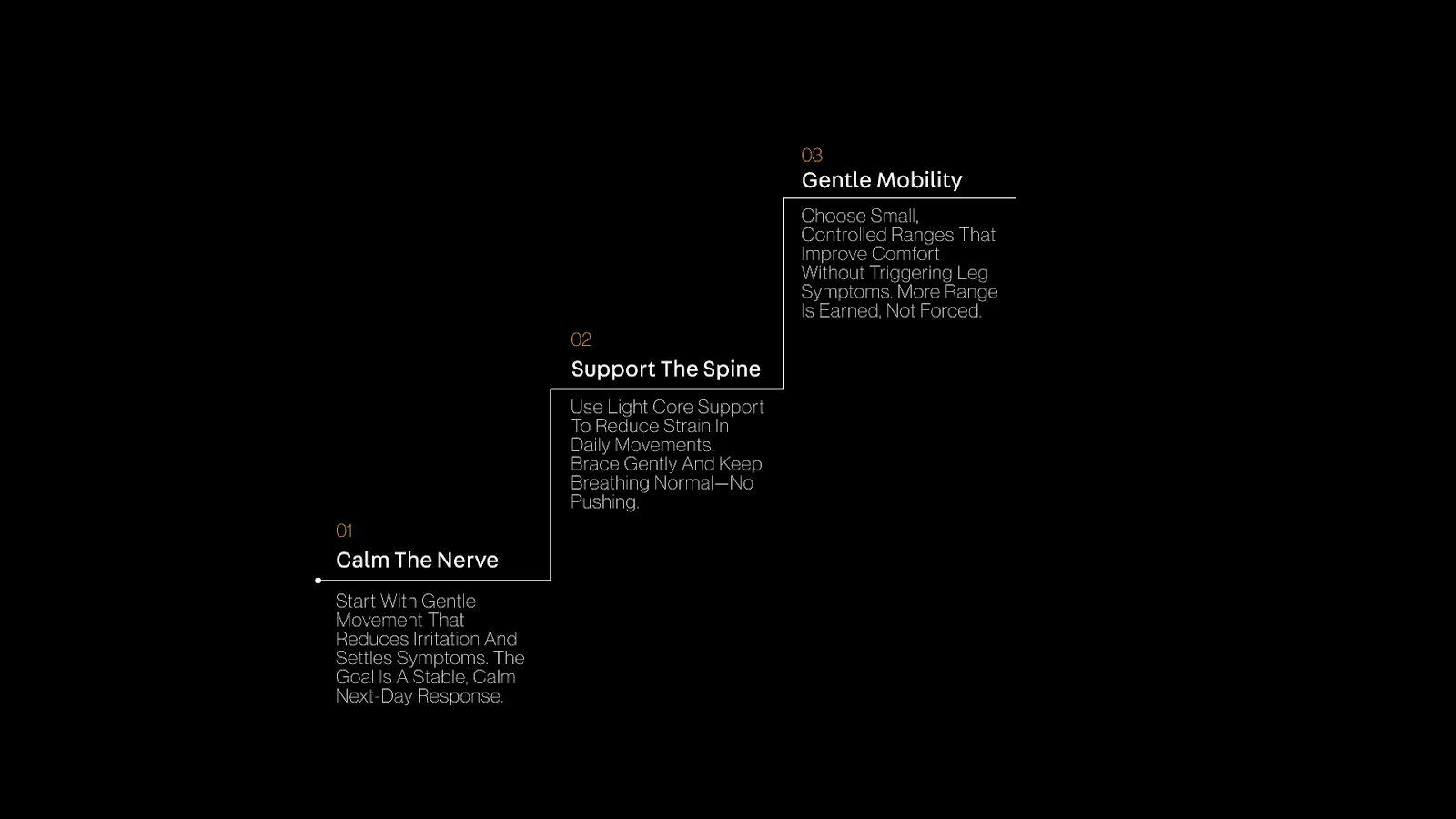
Exercises that support recovery tend to calm symptoms rather than challenge them. Low-load movement gives your body a chance to move without adding extra strain. Start with the option that feels most relieving and produces the most stable next-day response.
For many people, that starts with very simple options like short, comfortable walks, gentle rocking in a pain-free range, or a supported prone position that feels relieving. The goal is not to fix the disc in one session. The goal is to create a stable baseline your nervous system can trust.
Controlled Core Engagement for Spinal Support
Controlled core engagement can be useful, but the goal is support, not intensity. Slow, steady activation that allows you to breathe normally can reduce strain during everyday activities like getting out of a chair or turning in bed.
Simple examples that many people tolerate are gentle abdominal bracing while breathing, a slow bird-dog pattern with a small range, or a modified bridge if it does not trigger symptoms. If you have to hold your breath or push through shaking to finish, it is too much for now.
Mobility Work That Respects Disc Sensitivity
Mobility should improve comfort, not chase range. Small, controlled movement that avoids sharp or radiating pain is usually safer than deep stretching.
If a stretch feels like it pulls symptoms down the leg, it is usually a sign the nerve is too irritated for that approach today. In that case, less range and more control is often the faster path forward.
Exercises and Movements That Often Make Disc Symptoms Worse
Many popular exercises load the spine in ways that irritated discs and nerves do not tolerate well.
Repeated Bending, Twisting, and Loaded Flexion
Repeated bending, twisting, and loaded flexion are common triggers, especially if sitting or lifting already worsens your symptoms. These patterns show up in daily life and workouts and can keep the irritated area reactive.
This does not mean you can never bend again. It means that during an active flare, these are common positions to treat carefully.
High-Impact or Fatigue-Driven Exercise
High-impact or fatigue-driven exercise can also be problematic. Impact increases force, and fatigue reduces control. When movement control drops, the back often takes the hit.
Stretching Through Sharp or Radiating Pain
Stretching through sharp or radiating pain is another common mistake. Stretching should feel controlled and tolerable. If it creates electric, sharp, or spreading sensations, it is more likely to aggravate nerve irritation than help recovery.
When Herniated Disc Exercises Are Not Enough, and You Should Get Checked
Home exercises are a starting point, not a diagnosis.
If you are unsure whether you are improving, that uncertainty is common. Disc-related symptoms can fluctuate, and nerve sensitivity can make progress feel inconsistent. If progress stalls or symptoms worsen, particularly when leg pain, numbness, or weakness persist, it is time to get checked.
Symptoms That Should Not Be Managed With Exercise Alone
Persistent leg pain combined with tingling, numbness, or weakness is a strong signal to get assessed. If symptoms are severe, rapidly worsening, or include bladder or bowel changes, seek urgent medical care.
If you are unsure whether your symptoms fit a disc pattern, read our article on what a herniated disc feels like before deciding your next step.
Why Stalled Progress Is a Signal, Not a Failure
When symptoms are not changing despite careful effort, it usually means the exercise choice, the dose, or daily posture and load are not matching what your body needs.
The encouraging part is that many people improve with conservative care. Reviews show symptoms resolve in 60% to 80% of people within 6 to 12 weeks, and in 80% to 90% over the longer term.
What a Proper Disc Assessment Looks Like at ATLAS
If you feel stuck in a cycle of trying something new, flaring up, resting, and starting over, assessment is often the turning point.
What Is Assessed and Why It Matters
At ATLAS, assessment focuses on what matters for disc and sciatica symptoms: how your symptoms respond to key movements (bending, sitting, walking), whether nerve signs are present, which positions calm or aggravate you, and what load your body can tolerate right now. Then we turn that into a plan with clear checkpoints.
What Clients Leave With
Clients leave with clear findings explained in plain language, a measured care plan, and defined goals with checkpoints. That plan includes what to do now, what to avoid for the moment, what changes to watch for, and when adjustments should be made.
It also helps to know that most herniated discs improve without surgery. Cleveland Clinic reports that herniated disks get better on their own or with nonsurgical treatment for 9 out of 10 people.
If you want to move from guessing to a plan you can trust, contact ATLAS to book an evaluation.
Can a herniated disc heal with exercise?
The best herniated disc exercises are usually the ones that reduce symptoms during or after the movement and help you gradually tolerate more load. For many people, that starts with gentle walking, supported core control, and positions that calm nerve irritation (like lying on your back with knees supported, or a gentle “press-up” if extension feels relieving).
A good “best exercise” is not universal—it depends on your pattern. The best sign you’re on track is simple: your pain moves out of the leg and back toward the back, or your symptoms become less intense and less reactive over time.
What exercises should you avoid with a herniated disc?
Avoid exercises that consistently spike symptoms, especially if they push pain further down the leg or trigger tingling, numbness, or weakness. Common offenders include:
- deep forward bending early on (toe touches, heavy deadlift positions, aggressive hamstring stretching)
- loaded twisting (Russian twists, fast rotation drills)
- sit-ups/crunches if they increase back or leg symptoms
- high-impact jumping/running if it flares nerve pain
- any exercise that causes sharp pain, worsening leg symptoms, or lingering flare-ups for 24–48 hours
You don’t need to fear movement—you just need the right dose. If something repeatedly makes symptoms worse, it’s a sign the exercise is too much right now, not that you’re “broken.”
What are the best exercises for a herniated disc in the lower back?
The “best” exercises for a lower back herniated disc are the ones that reduce symptoms and help you gradually tolerate more movement without sending pain further down the leg. A safe, practical starting list (that fits many people) is:
- Short, frequent walking (5–10 minutes to start) to keep the back from stiffening and calm sensitivity.
- Gentle extension work if it feels relieving (often called a press-up / prone on elbows). Initial low back or leg pain might be felt, but should the pain continue to increase, stop.
- Core bracing + control (think “tighten around the spine” without holding your breath) using simple drills like a dead bug or marching.
- Glute/hip strengthening to reduce stress on the low back, like bridges or hip hinges with very light load.
- Pain-free mobility (small range, controlled) like pelvic tilts or cat-camel, only if they don’t flare symptoms.
A useful rule for choosing the right exercises:
Good sign: symptoms feel calmer or more local to the back (less leg pain/tingling).
Bad sign: pain travels further down the leg, numbness/weakness increases, or you flare for 24–48 hours.
If you have strong sciatica symptoms (tingling, numbness, weakness) or symptoms are worsening, it’s worth getting assessed so the plan is matched to your pattern.
Sources
- StatPearls (NCBI Bookshelf) — Sciatica overview and epidemiology
- Cleveland Clinic — Herniated disk (most improve without surgery)
- Mayo Clinic — Herniated disk: diagnosis and treatment (PT/exercise overview)
Final Thoughts
The goal of herniated disc exercises is not to push through pain or chase the hardest routine. It is to choose movements that reduce irritation, build stability, and help you function better in daily life.
If symptoms are improving steadily, keep things simple and consistent. If symptoms are spreading, stalling, or making you hesitant to move, that is your cue to reassess.
ATLAS supports clients with calm, clinically informed care that is measured and precise. If you want clear answers and a structured path forward, contact ATLAS to book an evaluation.