Kyphosis: Middle Back Pain and Your Nervous System

In the quiet moments as I work behind the scenes here at ATLAS, I often reflect on how much the body tries to protect us. Here in Hong Kong — with its long desk hours in tiny offices, crowded MTR rides where we hunch over phones, the constant hum of deadlines, and the subtle pressure of living in one of the world's most fast-paced cities — I've seen this same story unfold so many times. People describe a deep, nagging ache between the shoulder blades, rounded shoulders that simply won't relax, and a middle back that feels permanently stuck.
Clinically, we call this kyphosis — an exaggerated forward curve of the thoracic spine. But after years in practice and my own health journey, I've come to understand something deeper: kyphosis and middle back pain are rarely just a posture problem. More often, they are the nervous system's gentle way of saying it has been carrying too much, for too long.
The Thoracic Spine: Your Nervous System’s Protective Corridor
Your middle back is more than structural scaffolding. It houses the sympathetic chain of your autonomic nervous system — the part that quietly governs your stress response, breathing depth, heart rate, digestion, and even how much energy you have left at the end of the day.
When the thoracic vertebrae lose their natural, gentle curve and smooth mobility, it can subtly shift how these nerves fire. Over months and years, the body settles into a low-grade protective pattern: tighter muscles around the shoulder blades, shallower breathing, and a nervous system that stays a little too “on.” That state can show up as fatigue, brain fog, digestive unease, or that familiar deep ache — all experiences I know intimately from my own health journey.
During that time, my middle back became my most honest barometer. Whenever emotional exhaustion or unprocessed stress peaked, the area would tighten and round forward as if my body were trying to curl protectively around my heart. It wasn’t laziness or poor discipline. It was my nervous system doing its best to shield me. Once I stopped fighting that signal and started listening to it, real change finally began.
Modern Hong Kong life feeds this pattern almost perfectly: the long hours spent at desks and in front of screens, the forward-leaning posture we adopt on crowded commutes, the emotional tension we rarely name out loud (family expectations, financial pressure, the quiet fear of not keeping up), and the chemical load that comes with city living — processed foods, pollution, and the constant low-grade inflammation many of us carry without realising.
Why Quick Fixes Like Posture Correctors Usually Fall Short
I’m often asked about braces or wearable posture correctors. In the moment, they can feel kind — a gentle reminder to sit taller during a long workday or a little external support that eases the ache for a few hours.
From everything I’ve seen in practice and in the broader research, however, these tools don’t reach the root. They don’t restore natural spinal motion, rebuild the deep stabilising muscles of the upper back, or teach the nervous system how to feel safe in a more open posture. Without that foundation, the old protective pattern quietly returns once the brace comes off. They are a helpful pause, not a lasting solution.
The Three Gentle Practices That Actually Create Change
Real, lasting progress happens when we work with the body’s innate intelligence rather than against it. In my own recovery and in the lives of many people I’ve worked alongside, three elements together create the kind of shift that lasts.
1. Restoring motion and nervous system flow
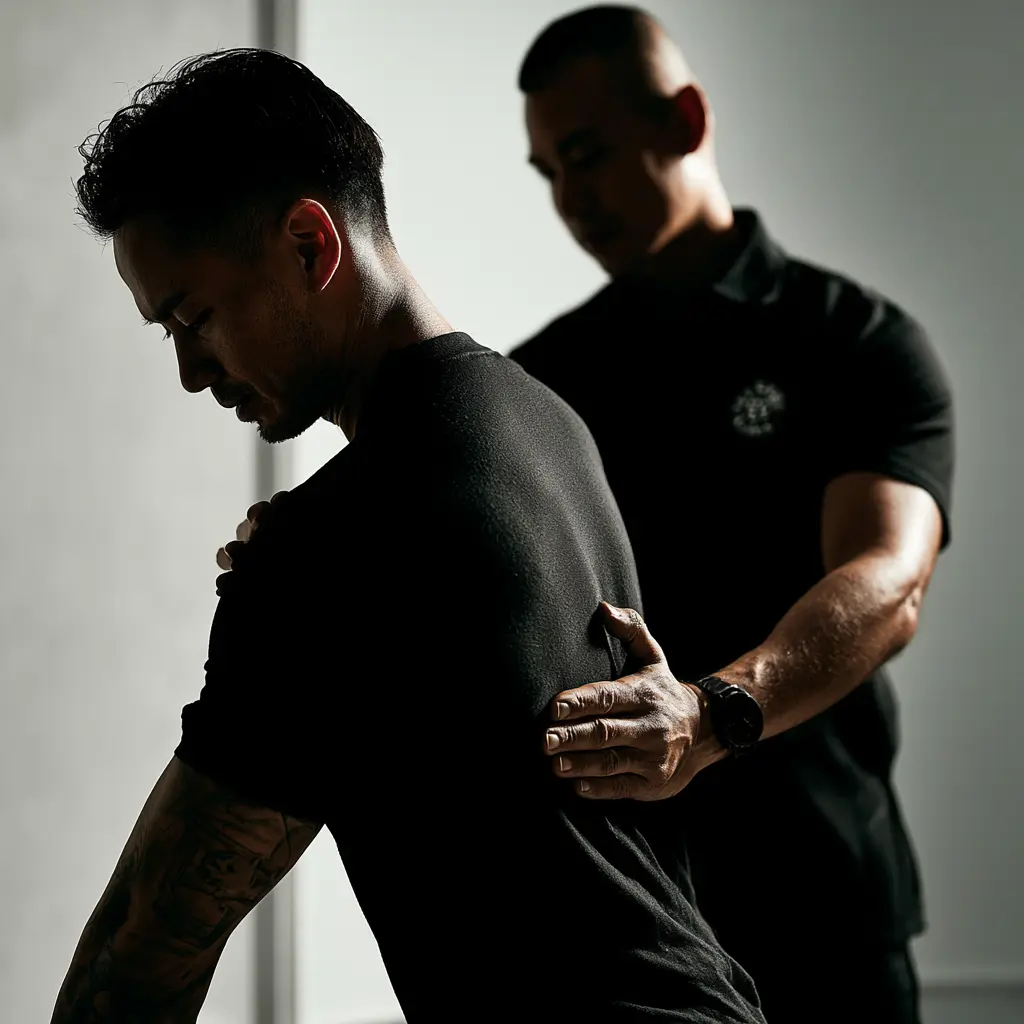
Gentle, specific chiropractic adjustments help free restricted thoracic segments. When natural motion returns to those individual vertebrae, the nervous system receives clearer signals. This segmental restoration is often the missing foundation — it makes everything else you do at home dramatically more effective. It’s not about forcing the spine straight or “cracking” anything dramatic — it’s about removing interference so the body can organise itself again, one careful adjustment at a time.
2. Softening the stressors that keep the pattern alive
This was the piece I missed for years. Even with good adjustments, unaddressed emotional stress would pull my posture forward again. I now pay close attention to three main categories of stress that affect the nervous system.
Physical — desk ergonomics, postural habits, shallow breathing, and old movement patterns.
Chemical — food choices, environmental toxins, and anything that quietly adds internal inflammation.
Emotional — the low-grade worry, perfectionism, or unprocessed tension so many of us carry in a high-pressure city like Hong Kong.
A simple daily question I still use — How is my nervous system feeling right now? — became one of the most powerful tools in my healing. When the emotional load lightens, the body responds with less guarding and better posture.
3. Gentle home practices that invite nervous system safety
These aren’t exercises to fix your posture. They are quiet invitations for your nervous system to experience that it is safe to open, to breathe more freely, and to let go of its protective rounding.
The real principle I discovered during my own health journey is this: it is not which movement you choose, but how you perform it. A simple thoracic movement done slowly, gently, and with the right intention will give you far more benefit than a complicated routine done with force or striving. We are not trying to force the spine open or aggressively correct the curve. We are gently showing the nervous system that a more open position is safe.

Three Home Practices for Kyphosis and Middle Back Pain
Gentle breathing in supported Child's Pose for posterior rib cage expansion
This practice encourages full thoracic expansion, especially into the back of the rib cage — an area that often stays restricted with kyphosis.
Kneel on the floor and sit your hips back toward your heels into a gentle Child's Pose. Place a pillow or folded blanket between your thighs and belly so you can relax fully forward without strain. Rest your forehead on the floor or a small pillow, and let your arms rest comfortably beside you or extended forward.
Breathe slowly and calmly through your nose. On each inhale, gently invite the back and sides of your rib cage to expand softly. On the exhale, allow everything to soften and settle naturally. Stay for one to three minutes. The slower and more present you are, the more your nervous system will feel safe to open the thoracic area.
Passive hanging for natural thoracic decompression
One of the simplest yet most powerful practices I discovered was hanging gently from a pull-up bar, sturdy doorframe, or even a strong tree branch. Just 10 to 40 seconds at a time, feet lightly touching the ground or completely off if comfortable. Let gravity do the work while breathing slowly and easily. No pulling, no effort — just allowing space to open in the thoracic spine.
If you don't have access to a bar, try the wall modification: stand facing a wall, place your palms flat at about shoulder height, then slowly walk your feet back a step or two while keeping your hands planted. Allow your chest to gently open and your upper back to lengthen. Let gravity create a soft traction — no pushing or pulling. Hold for 10 to 40 seconds, then slowly walk your feet forward to release.
Side-lying thoracic rotation with breath
This gentle movement helps restore thoracic rotation and rib cage mobility — areas that often feel locked in kyphosis.
Lie on your side with a foam roller, block, or pillow between your knees. Start with both hands together, arms outstretched in front of your chest. Keep the bottom arm resting on the floor. Slowly rotate the top arm in a wide arc — first overhead, then all the way across your body toward the floor on the opposite side — while following the moving hand with your eyes. Keep the top knee stacked on the bottom one. Move millimetre by millimetre. When you reach a sticky point, pause, breathe gently, and wait for the body to soften. Slowly return to the start and repeat.
The slower and more present you are, the more your nervous system will allow real change.
What My Own Recovery From Kyphosis Taught Me
During that time, my middle back told me the truth when my mind tried to push through. When life felt overwhelming, it tightened and rounded. When I finally began regulating my nervous system — through consistent gentle care, honest lifestyle reflection, and simple daily practices — the pain eased, my energy slowly returned, and my posture followed naturally.
That experience left me deeply humbled. The body is far wiser than we often realise. It simply needs the right conditions, a little space, and a lot of patience to remember its natural state of ease.
What Does Progress With Kyphosis and Middle Back Pain Look Like?
Most people notice their first subtle shifts within the first few weeks — easier breathing, less ache after long days, shoulders that feel a little lighter. Many experience meaningful change by the three to six month mark, when care and daily habits are consistent.
That said, for those who have carried this pattern for many years — or even a lifetime — deeper, lasting change in posture and nervous system regulation can take 18 to 24 months or longer. There is no rushing or forcing this process. The body opens up in its own gentle time, and that is perfectly okay. The nervous system heals in its own rhythm when it feels truly safe.
A Quiet Invitation
If you've been living with kyphosis or that persistent middle back ache, please know it doesn't have to be your normal. Your nervous system is remarkably adaptable. By approaching the issue with gentleness — supporting alignment, reducing hidden stressors, and practising simple regulation — you give your body the environment it has been waiting for.
I share these thoughts not as a prescription, but as one person who has walked a similar path and now walks alongside others. If this resonates, I invite you to begin with curiosity today: notice your posture and breath a few times, try one of the practices above, and see how your nervous system responds.
Your body is already on your side. Sometimes it just needs a little help remembering.
With gratitude for the shared journey toward wellness,
Dr. Ben Dyer, Mchiro, D.C.
Hong Kong Chiropractor Specialising in Nervous System Regulation & Holistic Well-Being