


Do Posture Correctors Work? Pros, Cons, and Better Fixes

If you have a desk job or you’re studying long hours, you probably know the pattern: your neck tightens, your shoulders creep forward, and your upper back starts working overtime. Then you see an ad for a brace and think, “Do posture correctors work, or is this just another quick fix that fades by next week?”
You’re not being dramatic. Neck pain is common worldwide, and the day-to-day triggers for office workers and students add up fast. In 2020, an estimated 203 million people were affected by neck pain globally.
Let’s start with what posture correctors can realistically do, then look at what it takes for lasting change.
Do Posture Correctors Work as a Short-Term Solution?
You are not wrong for wanting something that helps today. When your posture is slipping, and your neck is already irritated, a posture corrector can feel like a reset button.
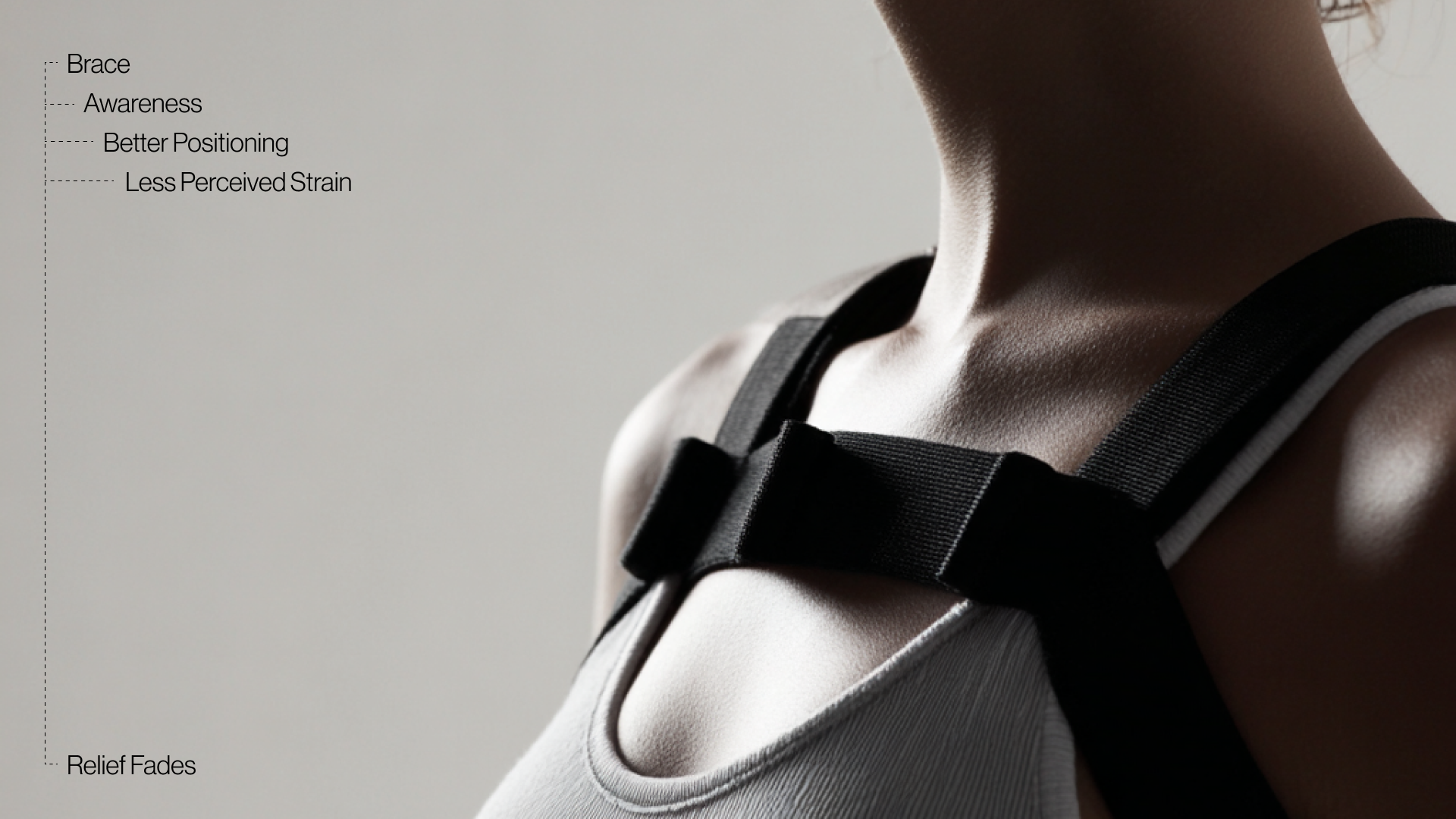
Why Do Posture Correctors Work at First for Many People
The first benefit is simple: you change your position.
When a brace pulls the shoulders back or makes slouching uncomfortable, many people notice less collapsing through the upper back and less “head forward” drift during screen time. That can translate into a temporary decrease in the feeling of strain, and that “lighter” feeling can be real. But it is important to name what is actually improving short-term: awareness, positioning, and perceived tension.
How Do Posture Correctors Work as Physical Reminders
Most posture correctors function as external feedback. They remind you, again and again, to stop rounding forward. They can limit extreme forward rounding and increase posture awareness during desk work or studying.
The catch is that awareness isn’t the same as lasting change.
They also change how you notice posture. Some research looking at scapular bracing during a 30-minute typing task found that bracing affected muscle activity, but did not produce meaningful immediate changes in pain, fatigue, or neck alignment. That is a useful reality check: a brace can influence positioning and muscle behaviour in the moment, but it is not a complete plan for comfort or long-term posture change. And that’s why what does not change is endurance, motor control, and postural habits.
Situations where short-term use may help:
- a focused study block
- a long meeting
- laptop work in a cafe where your setup is not ideal
A simple way to use a posture corrector more safely is to keep it task-based. Wear it for a short work block, then take it off and spend one minute holding the same “tall” position on your own while you breathe normally. That turns the brace into a cue instead of a replacement.
Keep it short and specific, so your body still learns to hold the position without support. If you stop at reminders alone, the relief often fades once the device comes off.
Do Posture Correctors Work for Long-Term Posture Change?
Here is the honest answer: posture correctors rarely create long-term change on their own, because long-term posture is not a decision you make once. It is the default your body returns to when you are tired, stressed, or focused on a screen. Now the bigger question is whether that improvement sticks when you are not wearing it.
Why Do Posture Correctors Work Temporarily but Not Long Term
The body defaults back under fatigue and stress.
Even if your posture is “better” for an hour, your system still has to hold that position when your upper back gets tired, your attention locks onto the screen, or you have been seated too long without movement.
This is why many people can “sit up straight” for a moment, but cannot maintain it. A posture corrector can hold you closer to the position, but it does not build the endurance required to keep it. Habits return once external support is removed.
Do Posture Correctors Work Without Rebuilding Control and Strength?
A brace is passive support. Posture is active control.
For desk workers and students, the issue is often not raw strength. It is endurance and coordination: can your upper back and shoulder stabilisers keep doing their job hour after hour?
In young IT professionals, one study found an average Neck Disability Index score consistent with mild neck disability and measures consistent with forward head posture. If that feels familiar, it helps explain why “just wear a brace” often falls short. The driver is usually a repeated work posture under constant load, not a one-time lack of willpower.
A posture corrector can reduce the amount you collapse into that pattern, but lasting change comes from rebuilding control, endurance, and capacity. Control is finding the position without forcing it. Endurance is holding it under real work demands. Capacity is recovering faster after long desk days.
Do Posture Correctors Work If the Nervous System Isn’t Involved?
Posture is a learned motor pattern. Your nervous system runs it like autopilot.
If your default is head-forward and shoulders-rounded, it is not because you are lazy. It is because your body has rehearsed that pattern thousands of times. Under pressure, it returns there automatically.
That is why reminders alone do not create lasting change. They do not retrain the autopilot. Retraining requires feedback plus repetition in real-life contexts. In practical terms, that looks like choosing a “better option” that you can repeat during real tasks. You set your screen, you lengthen tall through the upper back, you let your ribs move as you breathe, and you return to that option each time you catch yourself drifting.
Common contributors to recurring posture issues in office workers and students include:
- prolonged sitting load
- thoracic stiffness (upper back that does not move well)
- forward head compensation
- screen height and prolonged forward reach
What lasting change actually requires:
- assess
- retrain
- reinforce
- recheck
A second question people have is whether posture correctors can cause issues when they’re worn too long or fitted poorly.

Do Posture Correctors Work or Can They Create New Issues?
This is where skeptical readers usually lean in, because the concern is not just “will it help,” but “could it make things worse.”
Muscle Dependence and Reduced Internal Awareness
If you rely on a device for hours every day, your body can stop doing the work it should be doing. Over-reliance on external support can reduce engagement of postural stabilisers, and some people find they struggle to maintain posture without the device because it has been doing the job for them.
This does not mean everyone will “weaken” overnight. It means the strategy can become substitution: the brace does the work, so your system does not practice doing it.
Breathing Restriction and Rib Cage Compression
Many posture braces wrap around the chest and shoulders. If the fit is too tight or the design is too rigid, some people notice limited rib movement, shallow breathing patterns, and increased tension in the neck and upper chest.
Breathing matters because it changes what your upper body has to do. If your ribs do not move well, your neck and shoulders tend to work harder.
Fit, Skin Irritation, and Over-Correction Issues
Practical issues are common and rarely discussed clearly. Skin irritation and pressure points can show up fast, especially if the material rubs or the fit is not right. Poor fit and sizing issues can also push you into an uncomfortable position. Over-correction can create discomfort, especially if the brace forces a posture your body cannot sustain yet.
Clear stop-use signals to include:
- numbness or tingling
- restricted breathing
- increased headaches
- new shoulder or rib pain
None of this means posture correctors are “bad.” It means they work best as a tool inside a longer-term plan.
If you want a posture change that lasts, the goal is not to force your shoulders back all day. The goal is to build a system that improves how you sit, breathe, move, and recover, then measure whether it is actually working. Think of the brace as optional support; the plan is what creates change.
If you experience back pain when standing or walking rather than sitting, the issue may be less about posture devices and more about how the spine loads and stabilises during movement. Our article on how to stop back pain when standing or walking explains the mechanical patterns behind this and what ATLAS assesses.
Assessment Before Correction: Why Posture Needs Measuring
Posture is individual, not one-size-fits-all. Two people can look similar in a mirror and have very different drivers. That is why the best long-term results come from identifying structural and movement patterns first, then choosing the right plan.
Why Consistency and Follow-Up Matter More Than Devices
Progress requires repetition and feedback, then adjusting care based on response. Better-than-a-brace approach includes workstation setup, short movement breaks, mobility and endurance work, and breathing mechanics. Workstation setup can be as simple as bringing the screen closer to eye level and reducing how far your arms reach forward, so your shoulders are not constantly pulled into a rounded position. Short movement breaks do not need to be a workout; even standing up, letting the chest open, and taking a few slow breaths can reduce the "loaded" feeling that builds up during long sitting sessions.
Do posture correctors weaken muscles over time?
They can. But it depends on how you use them.
A posture corrector is basically an external “reminder” that holds you closer to a position your body might not be able to maintain yet. If you wear it for long periods, your brain and stabilizing muscles can start outsourcing the job to the device. Over time, that can reduce the very thing you’re trying to build: endurance and control in the upper back, shoulder blade muscles, and deep neck stabilizers.
The risk is higher when:
- you wear it for hours at a time (especially daily)
- you feel “held up” instead of actively controlling the position
- you don’t pair it with retraining (strength + endurance + mobility)
- you rely on it during every desk session
The risk is lower when:
- you use it as a short cue (not a full-day brace)
- you take it off and practice holding the same posture on your own
- you build endurance gradually (because posture is mostly endurance, not willpower)
A good rule: if the device is doing the work, your muscles aren’t. Use it briefly as training wheels, not as the bicycle.
Do posture correctors weaken muscles over time?
They can. But it depends on how you use them.
A posture corrector is basically an external “reminder” that holds you closer to a position your body might not be able to maintain yet. If you wear it for long periods, your brain and stabilizing muscles can start outsourcing the job to the device. Over time, that can reduce the very thing you’re trying to build: endurance and control in the upper back, shoulder blade muscles, and deep neck stabilizers.
The risk is higher when:
- you wear it for hours at a time (especially daily)
- you feel “held up” instead of actively controlling the position
- you don’t pair it with retraining (strength + endurance + mobility)
- you rely on it during every desk session
The risk is lower when:
- you use it as a short cue (not a full-day brace)
- you take it off and practice holding the same posture on your own
- you build endurance gradually (because posture is mostly endurance, not willpower)
A good rule: if the device is doing the work, your muscles aren’t. Use it briefly as training wheels, not as the bicycle.
How long should you wear a posture corrector each day?
Short sessions tend to be safer and more effective than all-day wear.
A practical approach is to treat it like a timer-based cue:
- Start: 10–20 minutes during one specific task (e.g., a Zoom call or focused writing block)
- Then: take it off and try to keep the same position for 60 seconds on your own
- Repeat: 1–2 times per day if it’s helping
As you improve, the goal is less reliance, not more time. If you’re still wearing it for longer and longer, you’re probably building dependence instead of control.
Stop and reassess if you notice:
- restricted breathing (too much rib cage compression)
- pressure points, tingling, or skin irritation
- increased neck pain or headaches
- shoulder pinching or numbness in the arms
- a “rigid” posture that feels forced rather than supported
The point isn’t perfect posture. It’s better control + less tension during real life.
What actually fixes poor posture long-term?
A long-term fix usually isn’t a gadget—it’s a system.
Most “poor posture” is really one of these:
- low endurance (you can’t hold a position for long)
- stiffness in key areas (upper back, hips, chest)
- poor workstation setup (you’re forced into the posture)
- stress/breathing patterns (you brace, shrug, and tighten without noticing)
A lasting fix usually combines:
1) Assessment (so you stop guessing)
Figure out what’s driving your posture: upper back stiffness, weak endurance, desk setup, breathing patterns, jaw/neck tension, or all of the above.
2) Targeted retraining (small, specific, repeatable)
- build upper back + shoulder blade endurance
- improve upper back mobility
- train “posture” as a skill (short daily reps > occasional big workouts)
3) Environment + habits (because posture is where you live)
Even strong people slump if their screen is low and their chair setup is wrong. A few setup changes can reduce strain immediately.
4) Clear checkpoints (to prove it’s working)
Instead of judging by “looks,” track real outcomes:
- less neck/shoulder tension by end of day
- fewer headaches triggered by desk work
- better recovery after long sitting
- you can sit/stand longer before discomfort starts
If those markers aren’t improving, you don’t need “more effort”—you need a better plan.
Sources
- The Lancet Rheumatology — Global, regional, and national burden of neck pain, 1990–2020, and projections to 2050 (GBD 2021) (supports the “neck pain is extremely common / large global burden” claim).
- PubMed — Effects of Using a Shoulder/Scapular Brace on Posture, Pain, Fatigue, and Neck Alignment During a Typing Task (short-term brace effects during computer work; supports “benefits may be limited/short-term”).
- CDC / NIOSH — Ergonomics and Work-Related Musculoskeletal Disorders (general ergonomics guidance for reducing work-related discomfort/injury; supports your workstation + load management advice).
- OSHA — Computer Workstations eTool (practical workstation setup principles; supports your desk setup recommendations).
Final Thoughts
So, do posture correctors work? Yes, in the limited sense that they can improve posture awareness and temporarily reduce the tendency to collapse forward during desk work. But they are rarely the long-term fix, because long-term posture is a system: structure, endurance, breathing, and repeatable habits under real-life load.
If you are dealing with recurring neck or upper back tension and you want a plan that is measured, consistent, and tailored to how you actually move and function, ATLAS can help clients take the guesswork out of posture and recurring tension. Book an assessment with ATLAS so we can build a clear plan you can follow and track over time.
For more general questions about chiropractic care in Hong Kong including cost, insurance, and what to expect at a first visit. See our chiropractic care Q&A page.


