Is Scoliosis Genetic? Hereditary Risk, Causes, and What You Can Do

A parent notices one shoulder sitting slightly higher than the other. A teen hears the word scoliosis during a school screening. An adult remembers a relative who had a curved spine and starts wondering if the same thing could happen to them. The question that usually follows is simple but unsettling: Is scoliosis genetic?
Many people assume that if scoliosis appears in the family, it must inevitably pass down to the next generation. The reality is more nuanced. Genetics can influence risk, but spinal development also depends on growth patterns, nervous system coordination, and structural balance throughout the body.
Understanding what research actually says about scoliosis causes can help families move from uncertainty to clarity. When risk factors are understood and monitored early, it becomes much easier to make informed decisions about spinal health.
Is Scoliosis Genetic or Hereditary? Understanding the Difference
The words genetic and hereditary are often used interchangeably, but they do not mean the same thing. Understanding that difference helps clarify why scoliosis sometimes appears in families but does not always follow a predictable inheritance pattern.
How Researchers Define Scoliosis Genetic Influence
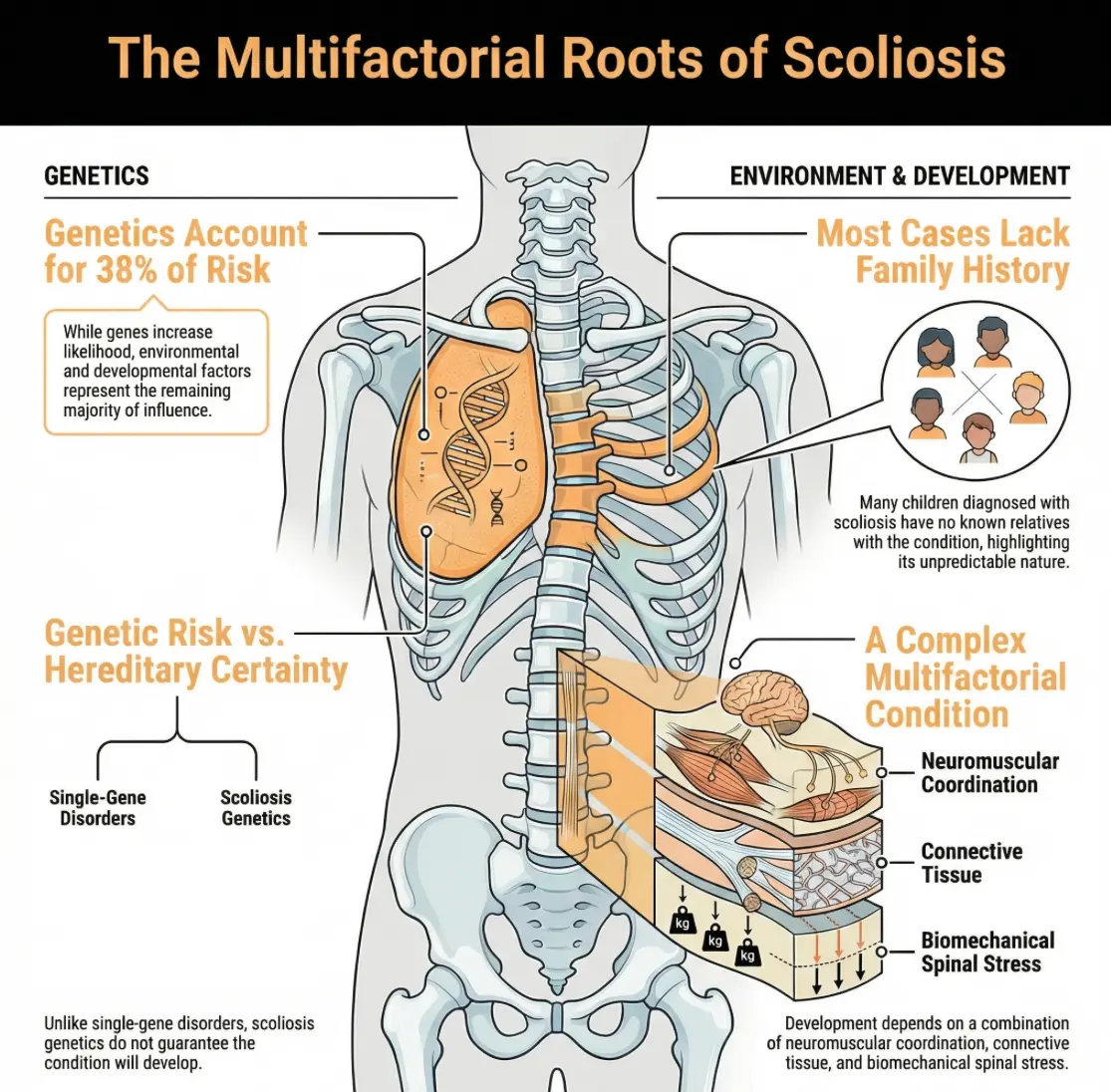
Medical research generally describes scoliosis as having a genetic influence, rather than being a strictly inherited disorder. Certain genes may increase the likelihood that spinal curvature develops, but they do not determine with certainty that someone will develop scoliosis.
A large twin study published in the journal Spine estimated that genetic factors account for roughly 38 percent of the risk for adolescent idiopathic scoliosis, while the remaining influence comes from environmental and developmental factors.
Because of this, two people with similar genetic backgrounds can still experience very different spinal outcomes. One sibling may develop scoliosis during adolescence, while another never shows signs of spinal curvature.
Why Hereditary Conditions and Genetic Risk Are Not the Same
Some conditions follow a clear hereditary pattern where a single gene directly causes disease. Scoliosis rarely behaves this way.
Most cases are classified as adolescent idiopathic scoliosis, which means the exact cause cannot be traced to one specific factor. Researchers believe several influences combine during growth, including genetics, neuromuscular coordination, connective tissue characteristics, and biomechanical stress on the spine.
This is why scoliosis is usually described as a multifactorial condition rather than a purely inherited one.
Why Many Scoliosis Cases Appear Without a Clear Family Pattern
Many people diagnosed with scoliosis do not have a close relative with the condition. According to the Mayo Clinic, most children diagnosed with scoliosis have no known family history.
This does not mean genetics plays no role. Instead, it highlights how many factors influence spinal development. A genetic predisposition may exist, but whether scoliosis actually develops can depend on growth timing, muscular balance, and how the spine adapts during adolescence.
Why Clinicians Ask Is Scoliosis Genetic During Evaluations
When someone comes in for a spinal evaluation, clinicians usually begin by asking about family history. That question helps place current symptoms or posture changes into context.
How Family History Helps Clinicians Identify Scoliosis Risk
If a parent or sibling has scoliosis, clinicians may recommend monitoring spinal development more closely during growth years. Research shows scoliosis appears more frequently among first-degree relatives than in the general population.
Family history alone does not confirm scoliosis, but it helps clinicians determine how closely spinal development should be observed during adolescence. Knowing that a relative has scoliosis can guide decisions about screening, monitoring growth changes, and scheduling follow-up evaluations during key growth periods.
Why Growth Patterns During Childhood and Adolescence Influence Spinal Curves
Scoliosis most commonly appears during rapid growth phases. When the spine lengthens quickly during adolescence, structural imbalances that previously went unnoticed may become easier to detect.
A child may have a symmetrical posture for years, then show signs of curvature during a growth spurt. This is why clinicians often track height changes and development milestones when assessing spinal health.
Why Clinicians Ask About Curve Progression, Symptoms, and Development History
During an evaluation, clinicians also ask about posture changes, balance, coordination, and visible asymmetry.
These questions help determine whether the spine is adapting normally to growth or whether structural changes may be developing. For example, gradual asymmetry during a rapid growth phase may indicate the need for closer monitoring to understand whether a spinal curve is stable, improving, or progressing over time.
What Research Says About Family History and Scoliosis
Scientific studies continue to explore the relationship between genetics and scoliosis. The evidence consistently shows heredity contributes to risk, but rarely acts alone.
What Twin Studies Reveal About Genetic Contribution to Scoliosis
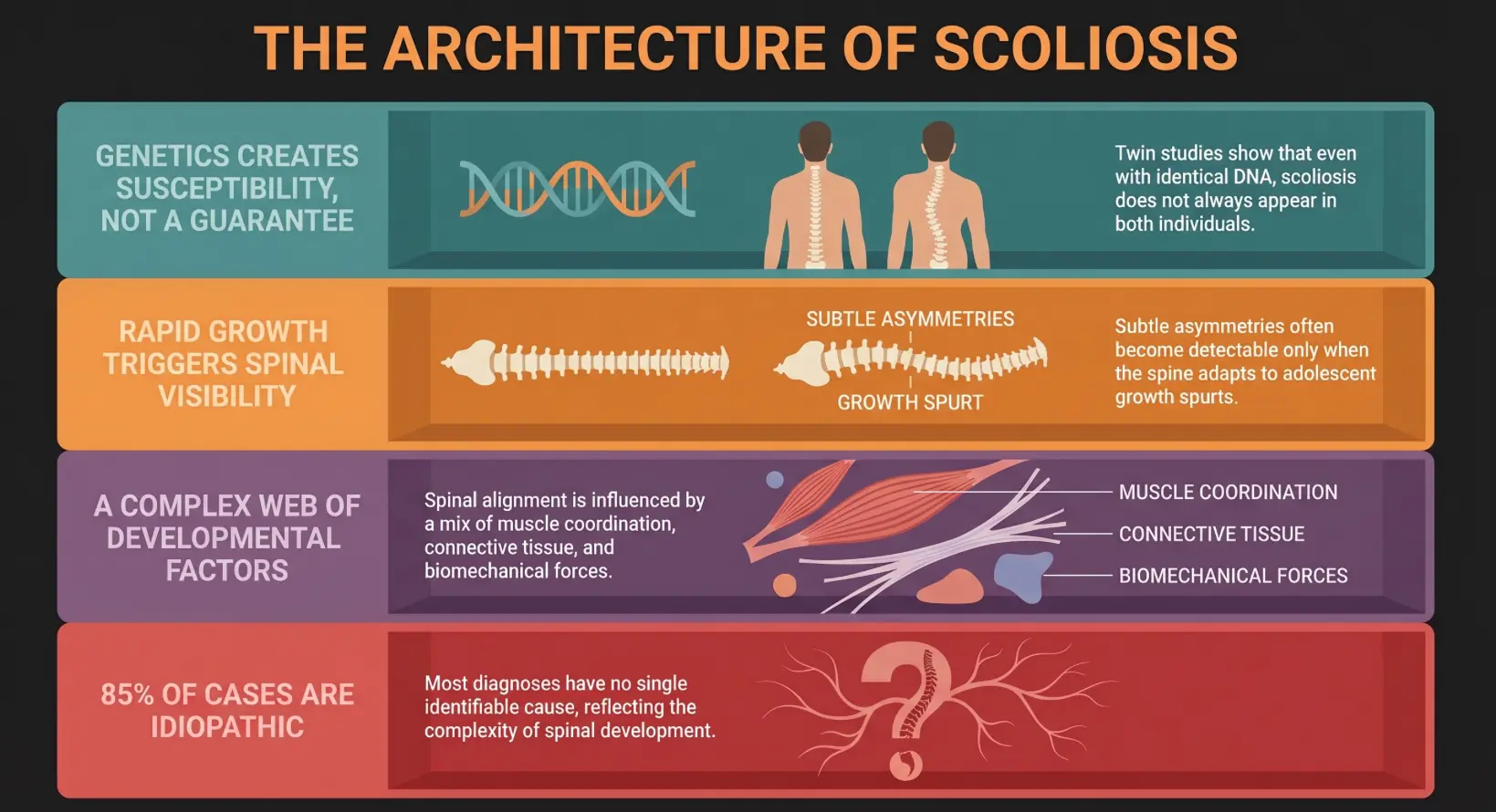
Twin studies provide a useful way to understand genetic influence. Identical twins share the same DNA, yet scoliosis does not always appear in both individuals.
This suggests genetics creates susceptibility rather than certainty. Environmental influences, growth timing, and neuromuscular coordination all interact with genetic predisposition during development.
How Often Does Scoliosis Appear Among First-Degree Relatives
Research shows scoliosis is more common in families where a parent or sibling already has the condition. However, the pattern remains unpredictable.
Some families may see several cases across generations, while others experience only a single occurrence. This variability highlights how genetic predisposition interacts with development rather than determining a guaranteed outcome.
Why Is Most Scoliosis Still Classified as Idiopathic?
Approximately 80 to 85 percent of scoliosis cases are considered idiopathic, meaning there is no single identifiable cause.
This classification reflects the complexity of spinal development. Genetics, growth patterns, muscle coordination, connective tissue structure, and biomechanical forces all interact as the body grows.
How Genetic Predisposition Interacts With Rapid Growth Phases
Rapid growth is often when scoliosis becomes visible. As the body grows taller, the spine must adapt to new mechanical demands and shifting balance.
During these growth phases, subtle asymmetries that previously caused no visible changes may become easier to detect, which is why many scoliosis diagnoses occur during adolescence.
How Growth and the Nervous System Influence Spinal Development
The spine does not function alone. It works as part of a coordinated system involving muscles, joints, and the nervous system.
Why Adolescent Growth Spurts Are the Most Common Period for Scoliosis Development
Most cases of adolescent idiopathic scoliosis develop between ages 10 and 18, when the body grows rapidly.
During this stage, the spine is lengthening quickly while muscles and coordination are adapting to new body proportions. Rapid skeletal growth can temporarily challenge balance and stability as the body adjusts to changing height and limb length.
How the Nervous System Coordinates Posture, Balance, and Spinal Control
Posture is controlled by the nervous system. The brain constantly receives information from muscles, joints, and sensory receptors to maintain balance.
During growth spurts, these systems must continually recalibrate. Temporary changes in coordination or body awareness can influence how the spine is supported during everyday activities like walking, sitting, and carrying weight.
How Asymmetrical Muscle Activation and Coordination Can Influence Spinal Alignment
Muscles surrounding the spine stabilize the body during movement. If muscle activity becomes uneven across the body, mechanical stress may be distributed differently along the spine.
Over time, uneven loading can contribute to structural adaptation, particularly during adolescence when the spine is still developing.
How Spinal Loading and Balance Change During Rapid Skeletal Growth
As children and teens grow taller, their center of gravity shifts. The spine, muscles, and nervous system must adjust together to maintain stability.
These adjustments are normal during growth, but they also help explain why clinicians pay close attention to spinal alignment during adolescence.
Types of Scoliosis and Why Causes Can Differ
Although many people associate scoliosis with adolescence, spinal curvature can develop in several ways depending on age and underlying conditions.
Adolescent Idiopathic Scoliosis and Why the Cause Is Often Unknown
Adolescent idiopathic scoliosis is the most common type. It typically appears during the teenage years without a clearly identifiable cause.
Researchers believe several influences combine during growth, including genetic predisposition, neuromuscular coordination, and mechanical forces acting on the spine.
Congenital Scoliosis and Spinal Development Before Birth
Congenital scoliosis occurs when the vertebrae form differently before birth. Structural differences in spinal bones can cause curvature early in childhood.
Because the vertebrae develop differently during fetal development, spinal alignment may already be altered at birth.
Neuromuscular Scoliosis Linked to Underlying Neurological Conditions
Neuromuscular scoliosis can develop when conditions affecting the nervous system influence muscle control around the spine.
When muscles cannot stabilize the spine evenly, curvature may develop as the body grows and the spine experiences uneven forces.
Degenerative Scoliosis Can Appear Later in Adulthood
In adults, scoliosis may appear gradually due to spinal degeneration, disc changes, or long-term mechanical stress.
This form develops differently from adolescent scoliosis and often reflects age-related structural changes affecting spinal stability.
If Scoliosis Is Genetic, What Can You Actually Control
Learning that genetics may influence scoliosis risk can feel discouraging. However, genetic risk represents only one part of the picture.
How Families Can Monitor Posture Symmetry During Growth Years
Parents and teens can occasionally observe posture during growth years. Looking for consistent patterns in body symmetry can help identify changes that may deserve attention.
Monitoring posture periodically during growth spurts can help families notice whether changes remain stable or gradually increase over time.
What Changes in Shoulder Height, Rib Position, or Waist Shape May Indicate
Visible changes sometimes include:
- uneven shoulder height
- a rib cage that appears more prominent on one side
- differences in waist shape
These signs do not confirm scoliosis, but they may suggest that the spine should be evaluated.
Why Structured Scoliosis Assessments Provide Clearer Answers Than Observation Alone
Observation at home can raise awareness, but structured spinal assessments provide clearer information about spinal alignment and function.
Clinicians can measure curvature, assess posture, evaluate movement patterns, and monitor how the spine changes over time.
How Strength, Coordination, and Balanced Movement Support Spinal Stability
Healthy movement supports muscular balance and coordination. Activities that build strength and body awareness help the body manage mechanical stress during growth.
Although exercise does not remove a structural curve, balanced movement helps support overall spinal stability and function.
When Monitoring at Home Is Reasonable and When Professional Evaluation Is Helpful
If asymmetry remains subtle and stable, simple observation may be reasonable.
However, if visible changes increase, appear suddenly during a growth spurt, or continue evolving, a professional evaluation can help determine whether scoliosis is developing.
Early Signs of Scoliosis Parents and Adults Should Watch For
Recognizing early signs of scoliosis helps families decide when an evaluation may be helpful.
Uneven Shoulders, Hips, or Rib Positioning
One shoulder may sit slightly higher than the other. In some cases, one hip or side of the rib cage may appear more prominent.
These differences can be subtle at first, which is why noticing gradual changes over time can be more helpful than relying on a single observation.
Why Clothing Fit and Body Alignment in the Mirror Can Reveal Asymmetry
Parents sometimes notice shirts hanging unevenly or pant legs appearing different lengths.
These everyday observations can reveal changes in body symmetry that might otherwise go unnoticed.
How Bending Forward Sometimes Reveals Rib Prominence or Spinal Rotation
When someone bends forward, a rib prominence may appear on one side of the back.
This simple observation is commonly used during basic scoliosis screening because it can make spinal rotation easier to detect.
When Should Visible Asymmetry Prompt a Scoliosis Assessment
If asymmetry becomes more noticeable, appears suddenly during a growth spurt, or continues changing over time, a spinal evaluation can help determine whether scoliosis is present.
Can Scoliosis Skip a Generation?
Genetic traits do not always appear consistently across generations. A grandparent may have scoliosis, while parents and children do not.
Because scoliosis involves multiple biological influences, it does not follow a simple inheritance pattern. A genetic predisposition may exist within a family even when the condition does not appear in every generation.
At What Age Does Scoliosis Usually Appear?
Most cases develop during adolescence, particularly during rapid growth periods.
Clinicians often monitor spinal development between ages 10 and 18, when structural changes are most likely to appear.
This period of rapid skeletal growth is when many scoliosis curves first become noticeable.
Can Posture Cause Scoliosis?
Poor posture alone does not create structural scoliosis. Slouching or uneven sitting may cause muscular discomfort, but it does not cause the structural spinal curvature seen in scoliosis.
However, posture habits can influence how mechanical stress is distributed across the spine and may affect comfort or muscle tension.
Should Siblings Be Checked for Scoliosis
If one child in a family has scoliosis, clinicians sometimes recommend monitoring siblings during growth years.
Because family history can increase risk, occasional screening can help ensure spinal development is progressing normally and allow earlier observation if changes develop.
Sources
NIAMS — Scoliosis in Children and Teens (supports general explanatory claims that scoliosis is a sideways curve of the spine, that many mild cases have little or no pain, that posture changes are common early signs, and that treatment depends on curve severity and may include observation, bracing, or surgery).
Mayo Clinic — Scoliosis: Symptoms and causes (supports claims that scoliosis is often diagnosed after age 10 or in the early teen years, that many cases are mild, that worsening curves can cause pain or breathing problems, and that common signs include uneven shoulders, waist asymmetry, or one hip sitting higher).
PubMed Central — Heritability of scoliosis (supports the claim that scoliosis can run in families and that genetics likely play a role, while also showing that environmental factors matter; this twin-registry study estimated that 38% of liability to develop scoliosis was due to additive genetic effects).
Final Thoughts
For many families, the question “Is scoliosis genetic?” leads to unnecessary worry. Genetics can influence risk, but spinal development is shaped by many factors, including growth, structural balance, and nervous system coordination.
Understanding how the spine develops helps families focus on what can actually be monitored and assessed.
At ATLAS, care begins with understanding how the spine and nervous system are functioning today. If you or someone in your family has concerns about scoliosis risk, booking a structured assessment can help determine whether the spine is developing normally and what steps may support long-term spinal health.