Posture Corrector: What It Is, Who It Helps, and How to Use It Safely

If you spend most of your day at a desk, you have probably noticed the pattern. Shoulders drifting forward, neck pulling toward the screen, upper back tightening by mid-afternoon. It is a common experience for office workers in Hong Kong, and it has driven a significant market for posture correctors - braces, shirts, and wearable devices that promise to pull the shoulders back and fix the problem.
The issue is that this framing is wrong. Posture correctors do not fix posture. At best they change how posture looks while they are being worn. At worst, used as a daily solution, they accelerate the very deconditioning they are marketed to prevent.
Understanding why requires a clearer picture of what posture actually is and what it takes to change it.
What a Posture Corrector Actually Does
Many people assume posture correctors fix posture. Most do not. They change how posture looks while they are being worn.
How a Posture Corrector Pulls the Shoulders Into Position
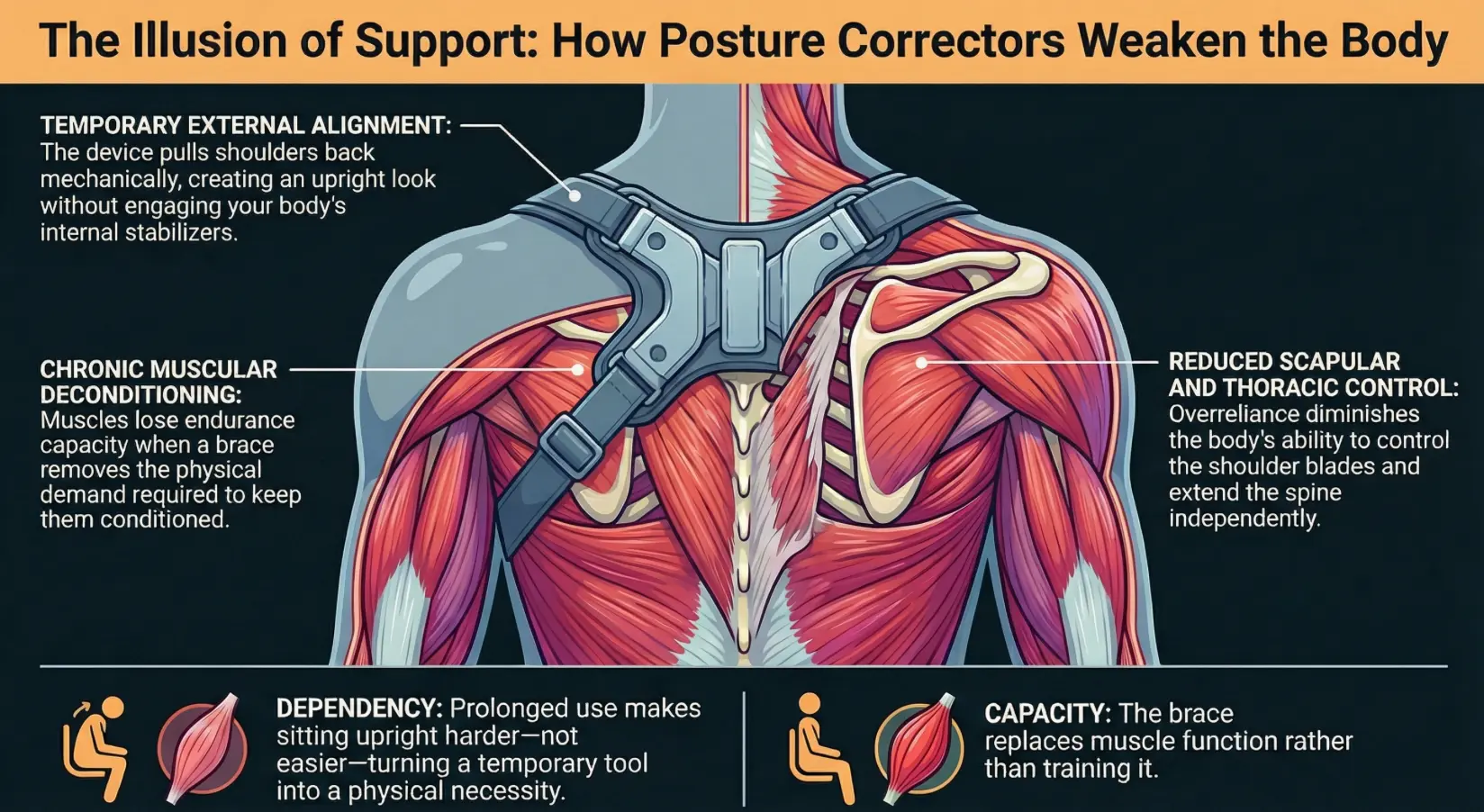
Most posture braces pull the shoulders backward and reduce the rounded position that many people fall into during long hours at a screen. That can make the upper body look more upright in the short term, and some people feel brief relief because the neck and upper back are not working in the same way.
The key limitation is that this is externally created. The brace holds the position. Your muscles are not being asked to control it.
What Changes Immediately, and What Stays the Same Once You Take It Off
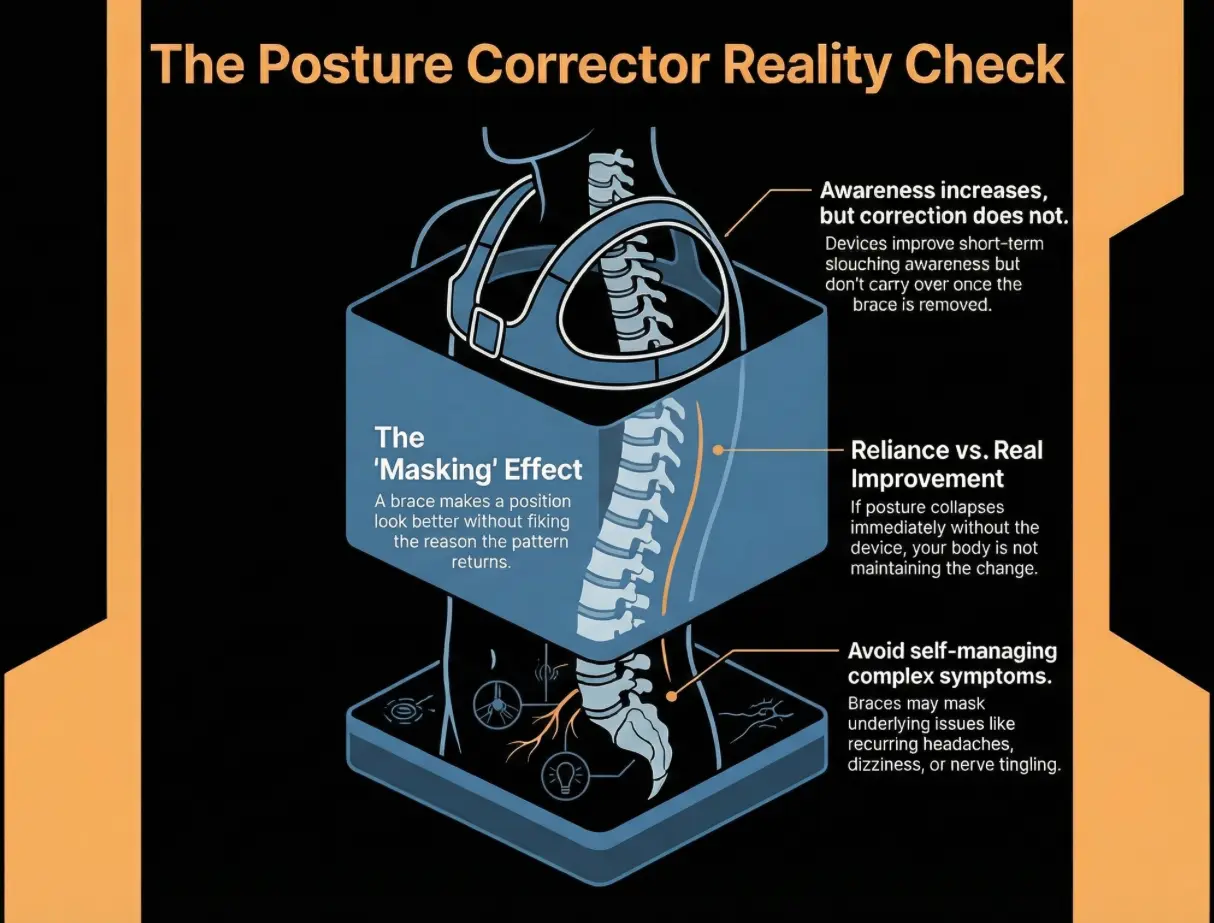
A posture corrector can influence alignment while it is on. Once it comes off, the body usually returns to the same pattern if the underlying drivers are still there.
In practice, this is what many people experience: posture looks better during use, but there is little carryover afterward. That is because nothing has changed in how the body produces or sustains that position.
Why Overreliance Leads to Muscular Deconditioning
Posture is an active process. It depends on the endurance of the muscles that support the upper back, the control of the shoulder blades against the ribcage, and the ability of the thoracic spine to extend and rotate. These are capacities the body has to develop and maintain through use.
When a posture corrector takes over the stabilising role of these muscles, it removes the demand that keeps them conditioned. This is not a theoretical risk. It is a straightforward consequence of how muscle tissue responds to load — or the absence of it. Muscles that are not required to work consistently lose their endurance capacity. This process is well established in rehabilitation science and is the same mechanism behind the deconditioning seen after prolonged bed rest or immobilisation.
In clinical practice, this is what prolonged posture brace use often produces:
- The upper back fatigues significantly faster once the device is removed
- Sitting upright without support becomes harder, not easier, over time
- The muscles responsible for scapular control and thoracic extension show reduced endurance
- The device stops being an occasional tool and becomes a dependency
The core problem is that the brace does the work instead of training the body to do it. Each hour worn is an hour those stabilising muscles are not being asked to function. Over weeks and months of regular use, this accumulates into measurable deconditioning — the very opposite of what the person is trying to achieve.
A posture corrector worn as a solution does not build capacity. It replaces it.
Why Poor Posture Develops in Desk Workers
Understanding why posture breaks down in the first place makes it easier to see why a passive solution has limits.
Most posture problems develop gradually through repeated daily demands.
Long Hours of Computer Posture and Laptop Use
Laptop screens usually sit too low, encouraging the head and shoulders to drift forward. Sustained hours in this position increase load through the neck and upper back. Over time, that position becomes the default.
Research published in PubMed Central shows that work-related arm, neck, and shoulder complaints are common among computer office workers, with daily computer use and incorrect body posture identified as significant predictors.
Forward Head Posture and Rounded Shoulders
When the head moves forward, the shoulders follow. This is not just a visual change. It alters how force is distributed through the cervical spine and upper back.
Research has shown that even small forward shifts in head position significantly increase the load placed on the cervical spine, requiring the neck muscles to work harder to support the head.
As the shoulders round, the shoulder blades tend to move into a more protracted and anteriorly tilted position. This means they sit further forward and lose their optimal alignment, which reduces how effectively the surrounding muscles can stabilise them. At the same time, the neck extensors have to work harder to hold the head up against gravity.
Thoracic Spine Stiffness and Reduced Scapular Control
The thoracic spine plays a key role in allowing the upper body to extend. When it stays flexed for long periods, extension becomes limited. This puts more strain on the neck and shoulders.
Reduced thoracic movement also affects how the shoulder blades sit and move. If the thoracic spine cannot extend well, the scapulae cannot position effectively, and maintaining an upright posture becomes mechanically harder.
Why the Body Defaults to the Easiest Position
When the system is fatigued or inefficient, the body shifts into positions that require less effort. Slouching is often a result of reduced capacity rather than a lack of awareness.
This is why external correction alone does not hold. The body returns to what it can sustain.
Do These Devices Actually Improve Posture
With that context in mind, the role of posture correctors becomes clearer. They can improve awareness in the short term. They do not reliably improve posture in a way that carries over without the device.
What Early "Improvement" Usually Means
In the first few weeks, people often notice:
- Increased awareness of slouching
- Temporary reduction in upper back fatigue during use
- A clearer sense of what upright posture feels like
These are useful, but they are not the same as correction.
How to Tell It Is Not Carrying Over
If posture collapses immediately when the brace is removed, the body is not maintaining the change. If upright posture feels harder without the device, reliance may already be developing.
Who Should Be Most Cautious
For some people, relying on a posture corrector can delay more appropriate care.
People with persistent or more complex symptoms should avoid self-managing with a brace alone:
- Recurring neck or upper back pain
- Headaches linked to posture
- Arm symptoms or tingling
- Dizziness
- Clear asymmetry or one-sided tightness
In these cases, posture is often only part of the issue. A brace may make the position look better without explaining why the pattern keeps returning.
What Matters More Than a Device
If posture is going to improve in a way that lasts, the focus needs to shift from holding position to building capacity.
Posture improves when the body becomes more capable, not more supported.
Desk Ergonomics and Screen Height
If your setup consistently pulls your head forward, that load will override any temporary correction. Raising the screen so it sits closer to eye level reduces the forward pull on the neck. Using a separate keyboard and mouse allows the arms to stay relaxed while the screen is positioned correctly.
Movement During Long Work Sessions
The spine does not need one perfect position. It needs variation. Remaining still, even in a "good" posture, leads to fatigue.
Short breaks every 45–60 minutes allow tissues to reset. Standing, walking, or briefly extending the upper back reduces accumulated load. This matters more than holding a fixed upright position for hours.
Strengthening the Upper Back
Improving scapular control and upper back endurance allows the body to hold posture without external support. This usually involves low-load, high-repetition work that targets endurance rather than maximal strength.
Research published in the Journal of Physical Therapy Science shows that exercise-based posture programs improve alignment, muscle activity, and pain more effectively than passive approaches alone, reinforcing the role of active rehabilitation.
Exercises that train controlled shoulder blade movement, particularly retraction and depression without excessive tension in the neck, help restore this function.
Restoring Thoracic Mobility
If the upper back cannot extend or rotate well, upright posture becomes difficult to sustain. Mobility work focused on thoracic extension reduces the need for the neck and shoulders to compensate.
When movement improves, posture requires less effort to maintain.
When a Posture Corrector Is Not Enough
A posture corrector is not an answer for:
- Recurring pain after desk work
- Persistent one-sided tightness
- Symptoms that continue despite "sitting straighter."
- Neurological signs such as tingling or dizziness
When these patterns persist, the issue is usually more specific than posture alone.
Understanding Posture and Neck Assessments
When self-management strategies are not enough, a more structured assessment becomes important.
At ATLAS, care begins with understanding how the body is functioning as a system rather than assuming posture is just a matter of trying harder.
How Posture, Spine Alignment, and Movement Patterns Are Evaluated
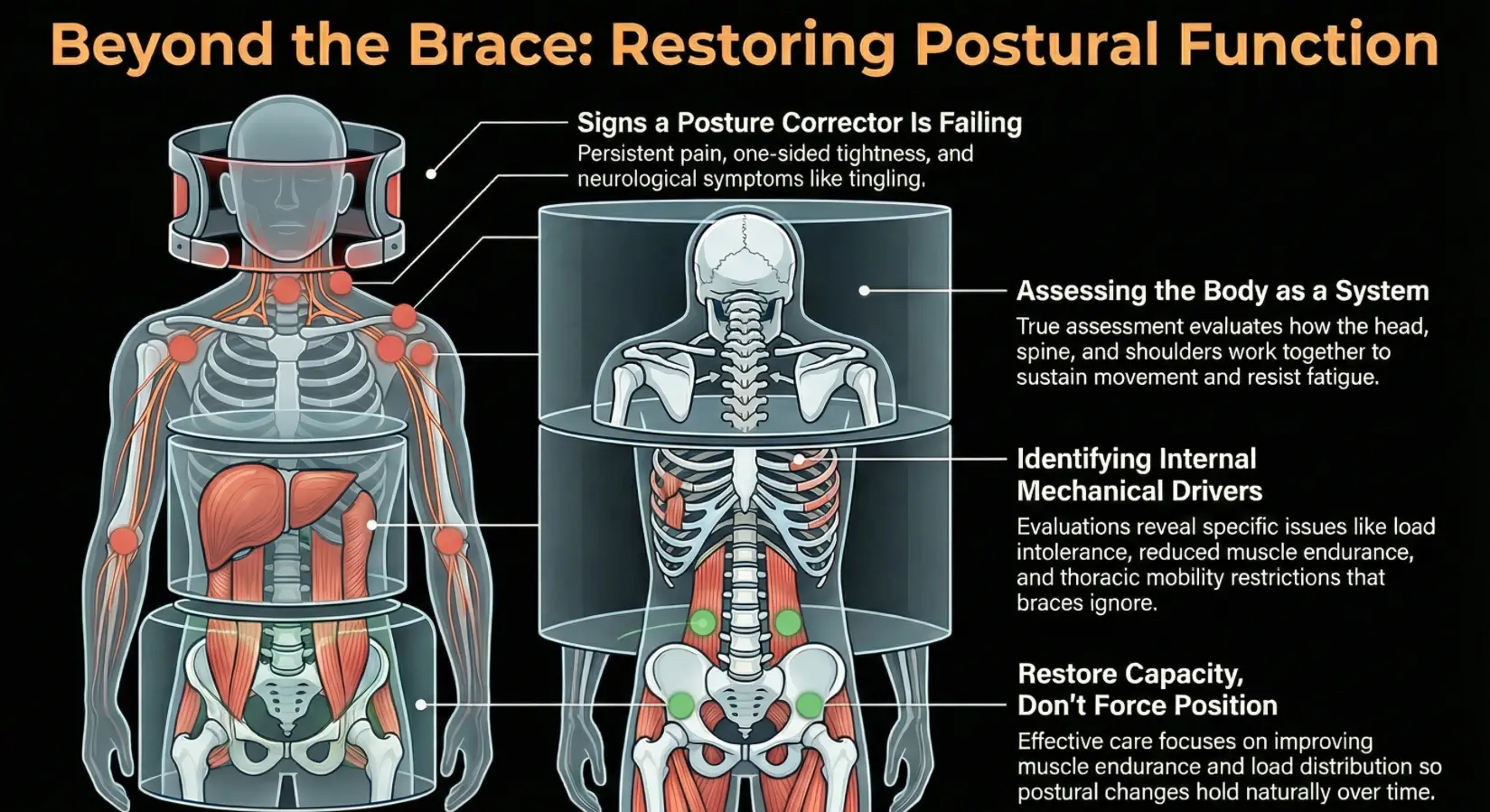
Assessment looks at how the head, shoulders, spine, and surrounding musculature work together during everyday movement. This includes how long a position can be sustained, how quickly fatigue appears, and whether one side of the body is compensating for the other.
Patterns such as early fatigue in the upper back, limited thoracic extension, or asymmetrical shoulder positioning often explain why posture collapses despite effort.
What Structured Assessment Can Reveal
A clear assessment can distinguish between different drivers:
- load intolerance from prolonged sitting
- reduced muscular endurance
- mobility restrictions in the thoracic spine
- asymmetrical movement patterns
- compensations that shift strain into the neck
This level of detail is what a brace cannot provide. It changes position, but it does not explain the pattern.
How This Guides Care
Once the main driver is identified, care can focus on restoring capacity rather than forcing position. That may involve improving endurance, restoring movement, or changing how load is distributed through the day.
This leads to changes that hold outside the clinic, not just during intervention.
Do Posture Correctors Really Work?
Posture correctors can improve awareness by helping you notice when you are slouching, and they may temporarily improve alignment while worn. However, posture depends on muscular endurance and movement, not just position. Because the device does not build that capacity, most people return to their usual posture once it is removed. They are best seen as a short-term cue, not a long-term solution.
Can Posture Correctors Weaken Back Muscles?
Yes, with prolonged use. When a posture corrector takes over the stabilising function of the upper back muscles, those muscles are no longer being asked to do their job. Muscle tissue responds to the demands placed on it — reduce the demand, and endurance and coordination decline. This is the same deconditioning process seen after any form of prolonged passive support. The muscles do not atrophy overnight, but consistent reliance on a brace over weeks and months progressively reduces the stabilising capacity of the upper back. The result is that posture collapses faster without the device, and the person becomes increasingly dependent on external support rather than their own muscular function.
Should You Wear a Posture Corrector Every Day?
No. Daily use, particularly for extended durations, actively works against the goal of better posture. Each hour worn is an hour the stabilising muscles of the upper back are not being required to function. Over time this leads to deconditioning — reduced endurance, weaker scapular control, and greater fatigue when unsupported. Many people who wear posture correctors daily find that their posture deteriorates once they stop, precisely because the muscles that should be holding position have been progressively offloaded. A posture corrector used as a daily solution is not a rehabilitation tool. It is a dependency that delays the structural changes that actually improve posture.
Can a Posture Corrector Fix Forward Head Posture?
A posture corrector can reposition the head and shoulders temporarily, but it does not address the underlying causes of forward head posture. These often include prolonged screen use, limited upper back mobility, and reduced muscular endurance. Without improving these factors, the body will return to the same pattern once the device is removed. Lasting change requires improving how the body moves and supports itself.
Sources
PubMed Central — Work-Related Musculoskeletal Disorders Among Computer Users: A Cross-Sectional Study (supports claims that prolonged computer use and sustained sitting are associated with a high prevalence of neck, shoulder, and upper back symptoms in office workers).
PubMed Central — The Effect of Forward Head Posture on Neck Load and Muscle Activity (supports claims that forward head posture significantly increases load on the cervical spine, requiring greater muscular effort from the neck and upper back).
PubMed Central — Effects of a Combined Exercise Program on Posture, Muscle Activity, and Pain (supports claims that exercise-based posture interventions improve alignment, muscle activity, and pain more effectively than passive approaches alone).
Final Thoughts
A posture corrector can change how posture looks, but it does not build the capacity required to maintain it. When used too often, it can reduce how effectively the upper back supports posture on its own.
If posture fatigue, neck tension, or recurring discomfort continue, it is worth looking beyond passive support. At ATLAS, assessments focus on how posture, structure, and movement interact so care can target the underlying driver rather than just the visible position.