Posture Exercises: The Best Movements to Fix Poor Posture

You've probably tried sitting up straighter, adjusting your chair, or following a quick routine you found online. It works for a while, then a few hours later, your shoulders drift forward again, your neck tightens, and you're back where you started. That cycle can feel frustrating, especially when you're putting in effort but not seeing lasting change.
For desk workers, posture is shaped less by a few minutes of effort and more by how your body holds itself for six to eight hours at a time. That's why posture exercises only start to work when they fit into how your body actually behaves across the day.
Why Posture Exercises Don't Always Fix Poor Posture
If posture exercises worked the way people expect, a few stretches and strengthening drills would be enough to fix everything. In reality, they often provide short-term relief without creating lasting change because they don't shift the pattern your body keeps returning to.
Why Posture Exercises Give Temporary Relief but Not Lasting Change
Most exercises go after the sensation. Tight chest, stiff upper back, sore neck. You stretch, you move, things loosen up, and it feels like progress.
Sit back down, though, and the same pattern shows up quickly. The screen hasn't moved. Your habits haven't changed. Within an hour, your head is forward again, and your shoulders are doing more work than they should.
Research published in PubMed found that unsupported sitting can increase lumbar disc pressure by about 40% compared with upright standing, which helps explain why discomfort builds up after long periods at a desk.
How Sitting Habits Quietly Undo Your Progress
Posture follows repetition. If your laptop is low, your head moves forward every time. If you sit for long stretches, your body gradually leans on joints instead of muscles.
By the end of the day, it's not that your posture suddenly failed. It simply drifted in the direction you've been reinforcing for hours.
What Posture Exercises Are Actually Correcting in Your Body
When posture is seen this way, the role of posture exercises becomes more specific. They are not there to force a position. They are there to change how your body organises itself.
Posture Is Coordination, Not Just Muscle Strength
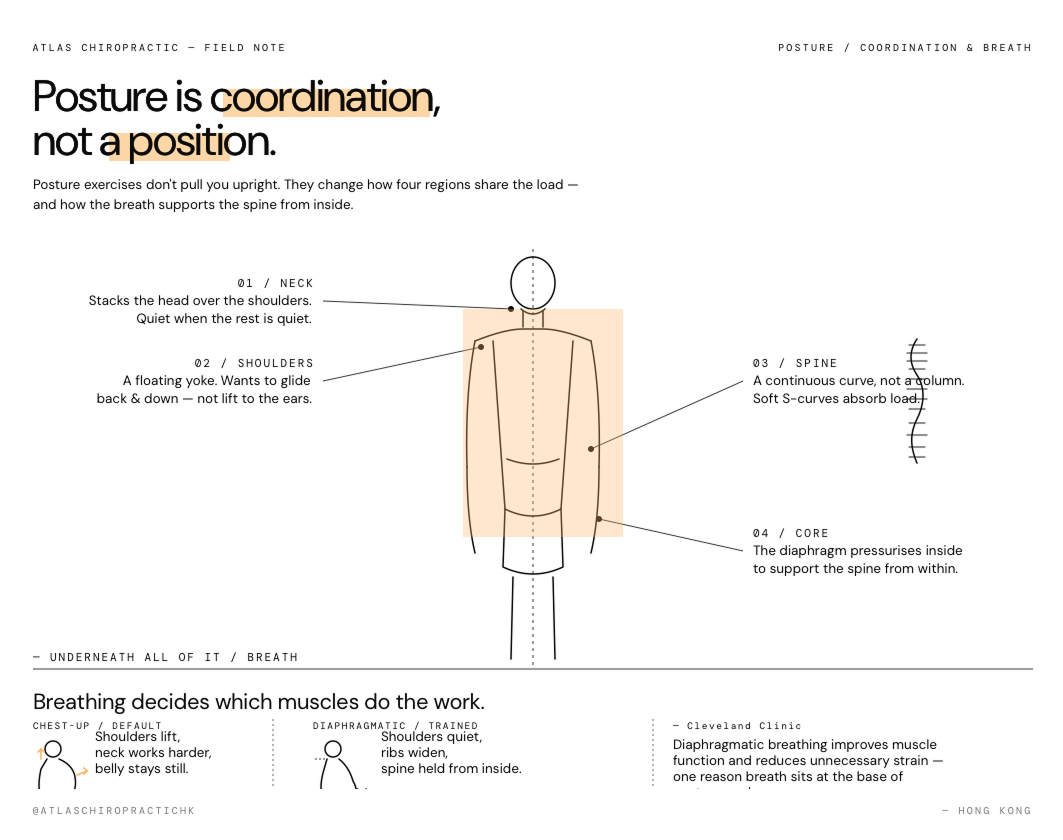
You can strengthen your back and still feel like your posture fades halfway through the day. That's because alignment depends on how well different areas share the load.
When the neck, shoulders, spine, and core coordinate well, posture feels steady. When they don't, certain areas take over. That's when you notice tightness at the base of the neck or between the shoulder blades after a few hours of work.
How Breathing and Spinal Positioning Change Stability
Breathing quietly influences all of this. When breathing stays high in the chest, the shoulders tend to lift, and the neck works harder. Over time, that becomes your default.
According to the Cleveland Clinic, diaphragmatic breathing can improve muscle function and reduce unnecessary strain, which is one reason breathing mechanics matter in posture work.
How Poor Posture Builds up Across a Normal Workday
You can usually feel posture change if you pay attention to your body at different points in the day.
Why Long Periods of Sitting Shift Your Alignment
In the morning, sitting upright feels manageable. You're more aware of your position, and your muscles are not yet fatigued.
By mid-afternoon, it often feels different. You start leaning into the chair, your head moves closer to the screen, and staying upright takes more effort than it did earlier.
Forward Head Posture, Rounded Shoulders, and Lower Back Fatigue
This is where most desk workers notice it. The neck starts to feel tight, especially at the base of the skull. The shoulders round without you realising it. The upper back stiffens, and by late afternoon, the lower back feels compressed.
A PubMed-indexed study found that office workers with neck and shoulder pain showed significantly different head, neck, and shoulder postures compared to those without symptoms.
The World Health Organization estimates that around 1.71 billion people worldwide live with musculoskeletal conditions, making them one of the leading causes of disability globally. Desk-based posture plays a role in that bigger picture.
The Best Posture Exercises for Tension, Support, and Control
With that context, posture exercises become more targeted. You're not just moving for the sake of it. You're addressing what your body has been doing for hours.
Reset Posture Exercises to Reduce Built-up Tension From Sitting
After a long stretch of sitting, the upper back often feels stiff, and the ribcage doesn't move as freely. Trying to sit straight at that point usually feels forced.
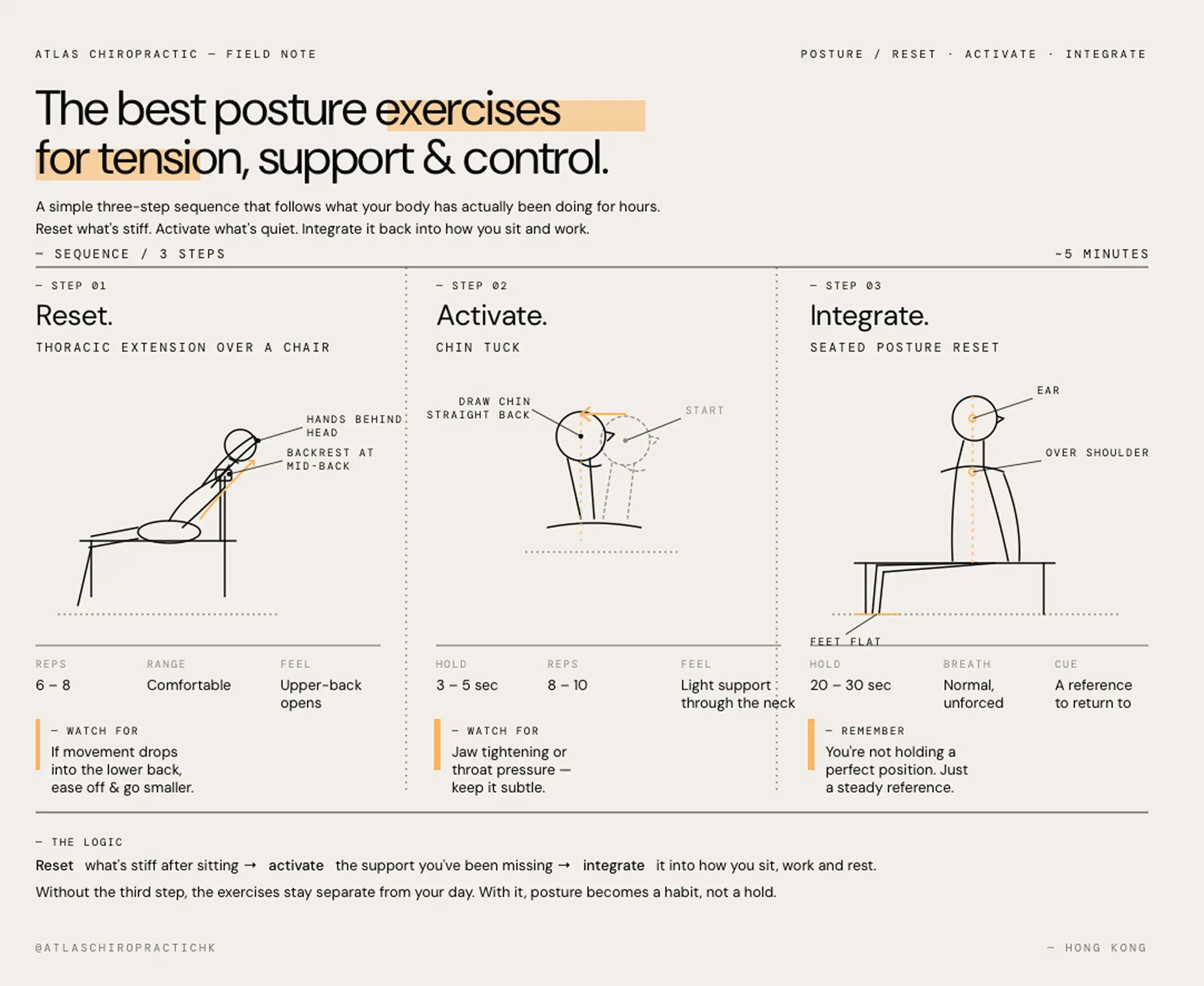
A simple thoracic extension over a chair can help. Sit with a firm backrest at mid-back level, place your hands behind your head, and gently lean back while looking slightly upward. Keep the movement controlled and within a comfortable range.
Perform 6 to 8 repetitions. You should feel the upper back loosen slightly and breathing become easier. If the movement shifts into your lower back, ease off and keep the motion smaller.
Activation Work to Support the Neck, Shoulders, and Mid-Back
Once movement improves, the next step is support. This is where your body learns to hold a better position without overworking certain areas.
A chin tuck is a simple starting point. Sit upright, look forward, and gently draw your chin straight back without tilting your head. Hold for 3 to 5 seconds and repeat 8 to 10 times.
Done well, this should feel like light support through the neck rather than strain. If your jaw tightens or you feel pressure in the throat, ease off and keep the movement subtle.
Integration Movements That Carry Posture Into Real-Life Positions
This is where posture changes begin to show up in your day. Without this step, exercises stay separate from how you actually sit and work.
A seated posture reset works well here. Sit with both feet flat, adjust your position so your ears sit roughly over your shoulders, and let your shoulders relax rather than pulling them back.
Hold this for 20 to 30 seconds while breathing normally. You're not trying to hold a perfect posture. You're giving your body a reference point it can return to.
How to Use Posture Exercises So the Results Actually Last
Once you have the right movements, the next step is making them part of your day rather than something separate from it.
A Realistic 5 to 10 Minute Structure for Busy Workdays
A short routine tends to work better than a long one. A few minutes to reduce stiffness, a few minutes to build support, then a short period of applying it in your normal position is enough.
This keeps the process manageable and easier to repeat.
How to Layer Posture Work Into Your Existing Routine Without Overthinking
It helps to attach posture work to moments that already exist in your day. Logging in, taking a break, or finishing work are all natural points.
When it fits into your routine, it becomes something you do without needing to think about it.
How to Choose and Progress Posture Exercises Based on Your Body
At this stage, the focus shifts to how your body responds rather than simply what you're doing.
When You Need More Mobility vs More Stability
If you feel stiff or restricted, your body likely needs more mobility work first. If you find that you can't maintain posture for long and fatigue sets in quickly, support and stability may need more attention.
These are not fixed categories. Most people need both, but the balance can shift.
Signs an Exercise Is Helping vs Wasting Effort
Progress is usually subtle at first. You might notice that your neck feels less tight by the end of the day or that you're not adjusting your position as often.
If those changes aren't happening after consistent effort, it's worth reconsidering whether the exercise is targeting the right area.
When Posture Exercises Stop Being Enough
There are times when progress slows down even with consistent effort. Two people can sit the same way but have different reasons behind it. One might feel stiff through the upper back, another might lack control through the neck, and another might notice their posture changes when they're tired or stressed.
In those situations, it helps to look more closely at how your body is functioning. For desk workers in particular, sustained spinal loading across a full workday often creates patterns that exercises alone do not fully resolve. At ATLAS, we assess those patterns directly. Instead of guessing which posture correction exercises to try next, we measure how your body responds and adjust the plan so it stays consistent and targeted.
How long do posture exercises take to work?
Most people notice early changes within a few weeks, especially in reduced tension and awareness. You might find that your neck doesn't feel as tight by the end of the day or that you don't need to keep correcting your posture as often. More lasting changes take longer because they depend on how consistently those patterns are repeated throughout the day.
Can posture exercises fix a hunched back?
Posture exercises can improve a hunched posture when it is linked to prolonged sitting and muscle imbalance. In those cases, improving upper back movement and support can gradually change how you sit and stand. If the posture has been present for a long time or involves structural changes, progress may be slower and more dependent on a targeted approach.
Do you need to do posture exercises every day?
Daily practice usually works best, but it does not need to take much time. Short, consistent sessions allow your body to adapt more effectively. Even a few minutes, repeated regularly, can make a difference when paired with better positioning during work.
Sources
PubMed — Intradiscal pressure during different sitting postures. Retrieved from https://pubmed.ncbi.nlm.nih.gov/7209680/
PubMed — Office workers with neck and shoulder pain: head, neck and shoulder posture. Retrieved from https://pubmed.ncbi.nlm.nih.gov/11831210/
World Health Organization (WHO) — Musculoskeletal conditions. Retrieved from https://www.who.int/news-room/fact-sheets/detail/musculoskeletal-conditions
Cleveland Clinic — Diaphragmatic Breathing Exercises and Your Vagus Nerve. Retrieved from https://my.clevelandclinic.org/health/articles/9445-diaphragmatic-breathing
Final Thoughts
Posture exercises start to work when they are used in context. They are not a quick fix on their own. They are part of how your body adapts to your day.
When the right movements are introduced at the right time and supported by how you sit, stand, and work, changes begin to carry over instead of fading after a short period. That's where posture exercises become useful in a lasting way.
If the stiffness and rounding in your upper back feels like it goes deeper than a posture habit — if it builds with stress, fatigue, and the accumulation of long days — our article on kyphosis and middle back pain explores the nervous system connection behind this pattern and what creates lasting ease.
At ATLAS, the focus is on understanding how your posture behaves before trying to change it. We assess how your body moves, measure what's happening over time, and guide you with a structured approach that fits your routine. If you want your posture exercises to lead to real, consistent improvement, book an assessment at ATLAS and build from there.